LSC’s New Touch Tank Illustrates Climate Change by Connecting Guests Directly with Local Marine Life & New Virtual Reality Climate Time Machine Gives Never-Before-Seen View of the Past, Present, and Possible Future of Local Terrain Starting Jan 17
Ralph Izzo, Retired CEO of PSEG, and Wife, Karen, Make $1.5 Million Gift for Redevelopment of Touch Tank; Part of Multi-Year, Comprehensive Transformation of Center’s “Our Hudson Home” Gallery
JERSEY CITY, NJ, January 17, 2026 – Liberty Science Center, the premier experiential science and technology learning center in the country, unveiled today its new Touch Tank and Climate Time Machine VR experiences. Both are components of a comprehensive reimagination of LSC’s flagship “Our Hudson Home” exhibit that, when completed in about two years, will result in a state-of-the-art, fully immersive and interactive 6,600-square-foot exhibition gallery known as “River Rising” focused on educating and engaging visitors of all ages on the very real impacts of climate change on the region’s marine life and environment.
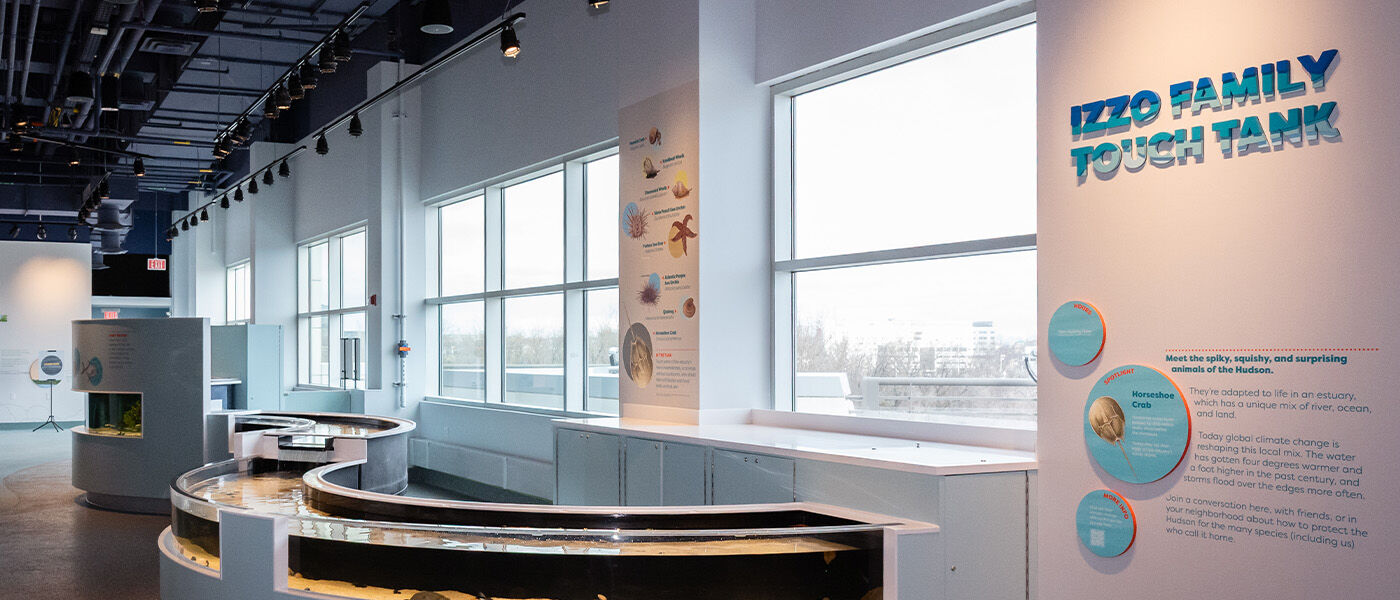
Opening today, the new Izzo Family Touch Tank–made possible through a $1.5 million gift from Ralph Izzo, the retired CEO of PSEG and Board member of the Center, and his wife, Karen, a retired biologist–brings a 29-foot-long, 1,000-gallon system inspired by a winding, rippling riverscape, across two levels connected by a waterfall, that looks out onto the Hudson River from floor-to-ceiling windows. Designed to tell a crucial story about how marine life in the region is affected by climate change, the new Touch Tank showcases seven species native to the Hudson River for guests to meet and bond with in engaging ways, while coming to understand how they can take action to protect the future for these animals and ourselves.
Each species in the tank relates to a key climate change challenge, and trained LSC STEM educators will foster conversations around these challenges. For example, guests meet prehistoric horseshoe crabs; they’ve existed for 450 million years but their spawning grounds are now at risk from sea-level rise. Visitors can also feel the knobby shells of sea snails, which ocean acidification makes brittle, and encounter sea stars, whose range may expand northwards as waters warm.
The new Izzo Family Touch Tank reflects the Center’s goal of employing a research-driven approach to educate visitors of all ages on climate change via connections with animals. To that end, the Center has partnered with the Conservation Psychology Research and Evaluation Lab from Montclair State University to provide feedback on educator-guest interactions with the aim of increasing visitor empathy, knowledge, and willingness to participate in conservation efforts for marine life in the Hudson River estuary.
LSC President and CEO Paul Hoffman expressed his deepest appreciation to the Izzos for their beneficence, noting that they have always been visionaries, in both their professional and personal lives. He cited the fact that Ralph Izzo, who earned his doctorate in applied physics from Columbia University, was an early advocate of fusion energy, viewing it as a potential path away from petroleum and fossil fuels.
“I cannot overstate how significant an impact Ralph and Karen have made in the energy industry, in philanthropy, and in their stalwart commitment to Liberty Science Center,” said Mr. Hoffman. “Their far-reaching vision for the Center is only matched by their passionate leadership in helping steer us to realize that vision. And this latest magnificent gift from them is testament to this leadership, as well as to their conviction that it is only by expanding access to STEM (Science, Technology, Engineering, and Math) education programs like those offered by the Center can we engage and empower generations of young people to meet the greatest societal challenge of our day, climate change.”
In this regard, Mr. Hoffman explained that the new digital VR viewfinder called the “Climate Time Machine” lets guests explore the Center’s stunning view of the Hudson in the past (when mammoths roamed), the present, and possible futures. By peering through the VR device, visitors will see immersive visual timelapses of how the area has changed over tens of thousands of years, from the coldest days of the Ice Age to today and beyond, to a warmer tomorrow that depends on the energy and climate change choices we make today. They’ll be able to see how our decisions can shape the future for the better, as when people worked together to successfully clean up pollution in the Hudson.
Both the new Touch Tank and Climate Time Machine are components of a comprehensive reimagining of the Center’s longtime “Our Hudson Home” gallery. LSC plans to renovate the remainder of the gallery, transforming it into a new 6,600-square-foot exhibition space called “River Rising” that deepens visitors' understanding of the Hudson and the urgent challenges it faces due to climate change. The reimagining of the gallery is part of LSC’s planned Project Supernova expansion that is supported by the Cultural Arts Facilities Expansion (CAFE) Program of the New Jersey Economic Development Authority.
“Climate change impacts every area of the Hudson,” Mr. Hoffman said. “Our goal is to weave the story into every area of the gallery.”
The new Izzo Family Touch Tank and Climate Time Machine are now open daily, and are free with Liberty Science Center admission.
About Liberty Science Center
Liberty Science Center (LSC.org) is a 300,000-square-foot, not-for-profit learning center located in Liberty State Park on the Jersey City bank of the Hudson near the Statue of Liberty. Dedicated to inspiring the next generation of scientists and engineers and bringing the power, promise, and pure fun of science and technology to learners of all ages, Liberty Science Center houses the largest planetarium in the Western Hemisphere, 12 museum exhibition halls, a live animal collection with 110 species, giant aquariums, a 3D theater, live simulcast surgeries, a tornado-force wind simulator, K-12 classrooms and labs, and teacher-development programs. More than 280,000 students visit the Science Center each year, and tens of thousands more participate in the Center’s off- site and online programs. Welcoming more than 800,000 visitors annually, LSC is the largest cultural institution in New Jersey and the largest interactive science center in the NYC-NJ metropolitan area.