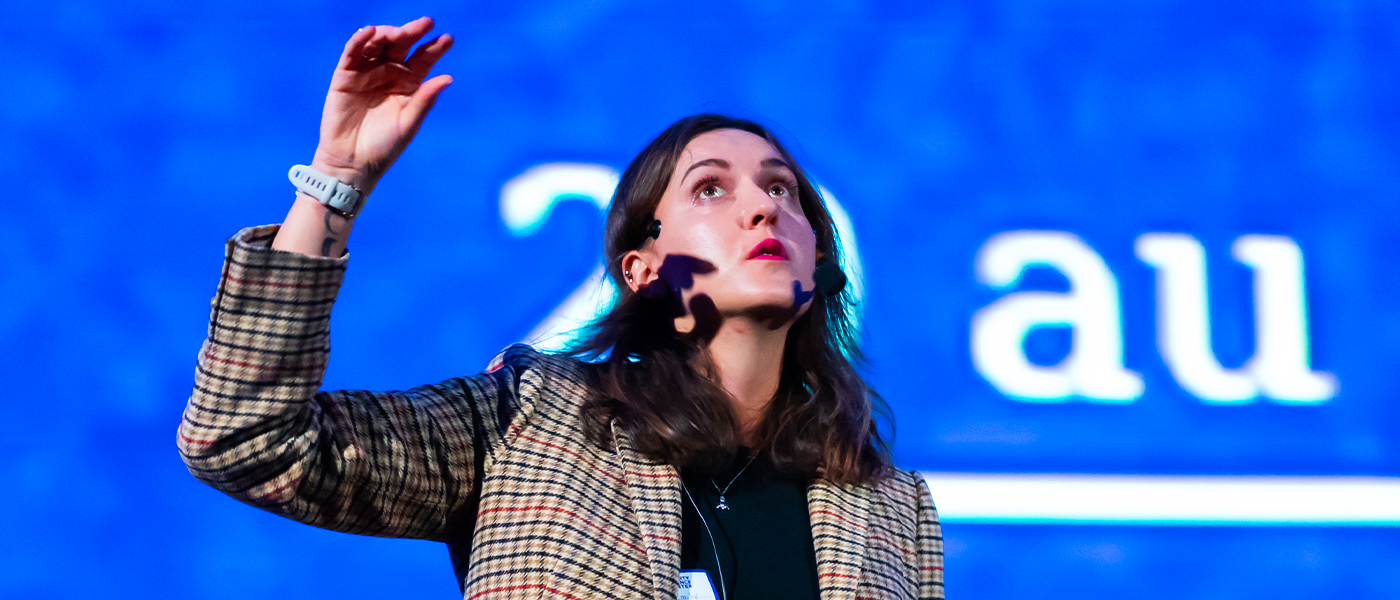
Exoplanets and the James Webb Space Telescope with Dr. Emily Rickman
On December 18th, the Jennifer Chalsty Planetarium was thrilled to welcome back Dr. Emily Rickman, an astronomy researcher with the Space Telescope Science Institute for her second Space Talk. Dr. Rickman works with the James Webb Space Telescope to search exoplanets, planets outside of our own solar system, for signs that they might be like the Earth.
The James Webb Space Telescope is able to study exoplanets, and measure the ingredients in their atmospheres, using a technique called spectroscopy. When one of these exoplanets passes in front of its star, light passes through the atmosphere of a planet. The telescope can then look for the unique “fingerprint” of elements or molecules in the light to determine the composition of a planet’s atmosphere. Using the largest planetarium in America, we were able to leave Jersey City to visit some of these exoplanets like Wasp-17b, a hot, roughly Jupiter-sized exoplanet, with quartz in its atmosphere.
Dr. Rickman was also able to share with us some of the Webb Telescope’s first direct observations of exoplanets. To do this, the telescope’s cameras have to block out light from the exoplanet’s star revealing the planet itself. This includes a promising observation of a potential planet in the Alpha Centauri system, the closest star system to us. In the image below, the first two panels show the star system itself while the panel on the right shows the image of the planet that, if confirmed to in fact be a planet, would be named Alpha Centauri Ab
This image shows the Alpha Centauri star system from several different ground- and space-based observatories: the Digitized Sky Survey (DSS), NASA’s Hubble Space Telescope, and NASA’s James Webb Space Telescope. The ground-based image from DSS shows the triple system as a single source of light, while Hubble resolves the two Sun-like stars in the system, Alpha Centauri A and Alpha Centauri B. The image from Webb’s MIRI (Mid-Infrared Instrument), which uses a coronagraphic mask to block the bright glare from Alpha Centauri A, reveals a potential planet orbiting the star.
Credit: Science: NASA, ESA, CSA, STScI, DSS, A. Sanghi (Caltech), C. Beichman (NExScI, NASA/JPL-Caltech), D. Mawet (Caltech); Image Processing: J. DePasquale (STScI)
Join us on September January 22nd, 2026 for our next Space Talk where we will welcome Dr. Huei Sears, Postdoctoral associate at Rutgers University to explore the Cosmic Microwave Background, the oldest light we can see in the Universe!