Live From Surgery
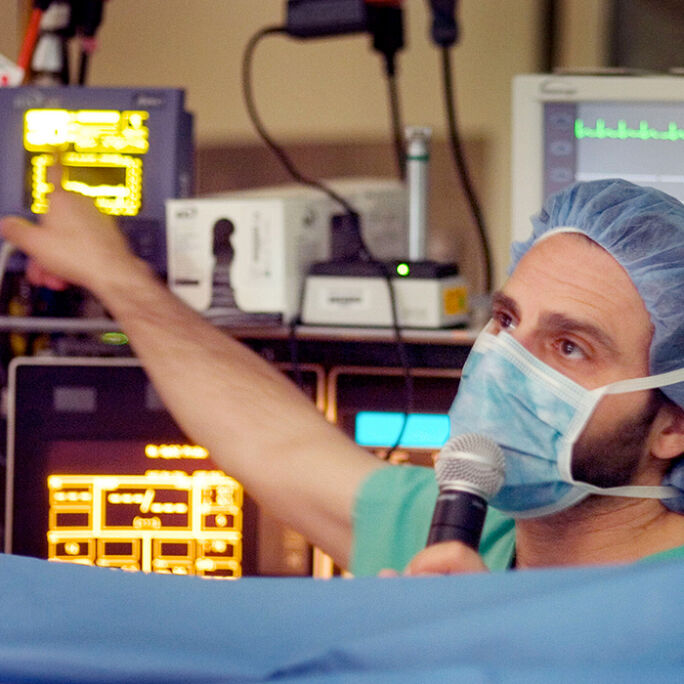
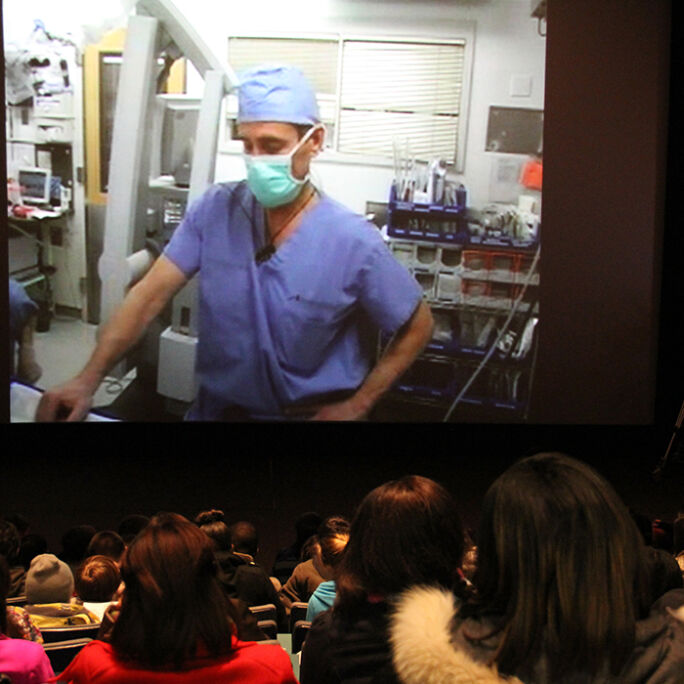
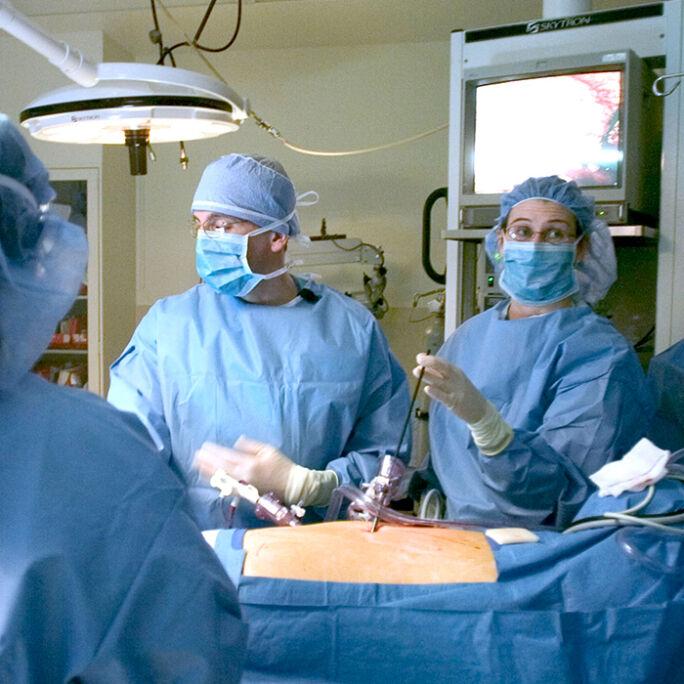
Liberty Science Center's Live From Surgery program offers students a unique opportunity to peer into an operating room and interact with medical experts. This powerful learning experience exposes students to careers in biotechnology and medical science. Live From Surgery sessions can be experienced at Liberty Science Center or transmitted into classrooms virtually. See the video conference technical requirements.
During each Live From Surgery session, students will view a procedure, communicate with the doctors, and make close observations of surgical instruments. During Meet the Surgeon sessions, a heart transplant surgeon or pediatric orthopedic surgeon will join live and present students with recorded footage from one of their procedures and discuss their career paths.
Our Live From Surgery Plus programs take the experience to the next level by enhancing your surgical session with a 45-60-minute laboratory workshop that brings medical science to life. Choose to add a session on real-life lab skills, healthcare career exploration, or another focus.
Live From Surgery, Meet the Surgeon, and Live From Surgery Plus sessions must be booked in advance. Please note that space in individual programs is open to multiple schools/organizations. These programs have the potential to sell out, so secure your spot now! Please also note that live surgeries may be transitioned to a taped surgery due to a cancellation or postponement of the scheduled surgery. Participants will be notified in advance when possible.
Email us at partnerships@lsc.org for more details or fill out our info form to make a reservation. An LSC team member will respond to you soon!

Note: When hospitals are busy, surgeries scheduled for Live From Surgery connections with operating rooms in our partner institutions may be rescheduled with little notice. Please note if the hospital reschedules a procedure, LSC will be ready to present a taped surgery.
Upcoming Dates
Live From Surgery: Robotic Surgery
2.5 hours
The Hackensack University Medical Center collaborates with Liberty Science Center to show students of all ages the innovative use of technology in robotic surgery. Students can see a live robot-assisted laparoscopic surgery performed by Dr. Michael Stifelman and his team. Robotic surgery uses a surgical robot to allow surgeons to offer more patients the benefits of laparoscopic surgery, such as performing complex surgeries with fewer incisions.
LSC'S Live From Surgery enables students to ask our surgical team questions while they view the team performing an operation via video teleconferencing technology.
See the list below for dates:
Live From Robotic Surgery
October 22, 2025
December 17, 2026
January 21, 2026February 18, 2026 (In Neptune, NJ, Only)
March 18, 2026 (Virtual Only)
May 4, 2026
June 1, 2026
Live From Surgery: Kidney Transplant
2.5 hours
In partnership with the Renal Transplant Division at Cooperman Barnabas Medical Center under the RWJBarnabas Health system, Liberty Science Center offers live viewing of adult or pediatric kidney transplants. Students can watch surgeons perform live kidney transplants while surgeons provide educational information about treatment options, understanding transplantation, how to find a donor, and maintaining a healthy organ after transplant.
LSC's Live From Surgery enables students to ask our surgical team questions while they view the team performing an operation via video teleconferencing technology.
See the list below for dates:
Live From Kidney TransplantOctober 28, 2025 (Virtual Only)November 11, 2025 (Sold Out)
November 25, 2025 (Virtual Only)
December 9, 2025 (In Neptune, NJ Only)
January 13, 2026 (Virtual Only)
January 27, 2026 (Virtual Only)
February 10, 2026 (Virtual Only)
February 24, 2026 (Virtual Only)March 10, 2026 (Sold Out)
March 24, 2026 (Virtual Only)April 14, 2026 (Virtual Only)April 28, 2026 (Sold Out)
May 12, 2026 (Virtual Only)
May 26, 2026
June 9, 2026
Live From Cardiac Surgery
2.5 hours
Gagnon Cardiovascular Institute at Morristown Medical Center (Atlantic Health) collaborates with Liberty Science Center to produce Live From Cardiac Surgery, an educational program that allows middle and high school students to watch open-heart bypass surgery as it happens in real-time. Students in the classroom can ask the surgical team questions while they view the team performing an operation.
Live From Cardiac Classroom
November 21, 2025December 12, 2025 SOLD OUT
January 16, 2026February 13, 2026March 13, 2026 SOLD OUTApril 17, 2026 SOLD OUT
May 8, 2026
June 12, 2026
Live From Neurosurgery
3 hours
Learn about delicate neurosurgery performed to extract tumors from the brain or spinal column or repairing spinal column damage from the surgical team at Overlook Medical Center (Atlantic Health) in Summit, NJ. Hear about surgical procedure, risk factors, and careers in medicine.
Live From Neurosurgery
November 17, 2025 (Virtual Only)
December 15, 2026 (Virtual Only)
January 19, 2026
February 16, 2026
March 16, 2026 (Virtual Only)
April 20, 2026 (Virtual Only)
May 18, 2026 (Virtual Only)
June 15, 2026
Meet the Surgeon: Heart Transplant
2.5 hours
Learn about heart transplant surgery from a real surgeon! Join Margarita T. Camacho, MD, as she discusses one of her prerecorded heart transplant surgeries. Learn about risk factors for heart disease, mechanical hearts and assistive devices, and new cardiac transplant technologies and procedures. Gain a better understanding of the organ donation process and analyze data from past research on mechanical devices.
See the list below for dates:
October 16, 2025
November 13, 2025 NO LONGER AVAILABLE
December 11, 2025
January 15, 2026
February 12, 2026
March 6, 2026
April 9, 2026
May 14, 2026
June 18, 2026
Meet the Surgeon: Pediatric Orthopedic Surgery
2.5 hours
Learn about pediatric orthopedic surgery from a real surgeon! Interact with pediatric orthopedist, Dr. Samara Friedman, MD, as she describes her experiences in the surgical room. Hear about adolescent bone, joint, and muscle conditions and particular surgeries they performed.
Dr. Friedman is also affiliated with Morristown Medical Center (Atlantic Health), Cooperman Barnabas Medical Center, Overlook Medical Center (Atlantic Health), and Short Hills Surgery Center.
See the list below for dates:
October 3, 2025
November 14, 2025December 5, 2025 SOLD OUT
January 9, 2026
February 6, 2026
March 13, 2026
May 1, 2026
June 5, 2026
Surgical Insights Video Series
1 hour
These sessions feature our most popular procedures on videotape. Learn about Cardiac Surgery, Robotic Surgery, or Neurosurgery when you view a previously recorded procedure conducted at one of our partner hospitals. Our Live From Surgery educators will enhance the experience with relevant background and details, and will answer questions for your group.
Surgical Insights Video Series schedule
October 15, 2025 - Cardiac Surgery
November 19, 2025 - Robotic Surgery
December 3, 2025 - NeurosurgeryJanuary 14, 2026 - Cardiac Surgery (Sold Out)
February 11, 2026 - Cardiac Surgery
March 11, 2026 - Robotic Surgery
April 15, 2026 - Neurosurgery
May 13, 2026 - Cardiac Surgery
May 28 , 2025 - Neurosurgery
June 17, 2026 - Cardiac Surgery
Live From Surgery Plus: Bacteria Detective
Enhance your session with this optional add-on!
Students will step into the role of medical microbiologists to investigate a hospital-acquired infection outbreak. They'll learn the gram staining technique to identify an unknown bacterial sample, classify different types of bacteria, and understand their significance. Using microscopes, students will examine their stained slides to determine the type of bacteria present.
Bacteria Detective can be added to any Live From Surgery session.
Live From Surgery Plus: Beat the Next Pandemic
Enhance your session with this optional add-on!
In this immersive lab, students will act as healthcare providers to diagnose patients with flu-like symptoms using gel electrophoresis. Acting as lab technicians and medical professionals, they will discern whether their patients are suffering from seasonal fly or a new, dangerous virus. Students will work in teams as they load samples, run elecrtrophoresis, and analyze results to determine their patients' diagnoses.
Beat the Next Pandemic may be added to any Live From Surgery session.
NEW Live From Surgery Plus: Using Biotechnology to Stop Outbreaks
Enhance your session with this optional add-on!
Available at LSC. Take on the role of public health scientists investigating a potential outbreak traced through wastewater. Using gel electrophoresis, analyze DNA samples to identify bacterial pathogens and determine the source of contamination. This simulation uses real-world data and biotechnology tools to explore how wastewater surveillance can detect emerging diseases and protect community health.
Using Biotechnology to Stop Outbreaks may be added to any Live From Surgery session.
NEW Live From Surgery Plus: Exploring Diabetes and Semaglutide Science with ELISA
Enhance your session with this optional add-on!
In this lab simulation, students will explore how semaglutide, a cutting-edge medication, helps regulate blood sugar and reduce appetite in individuals with type 2 diabetes. Through a hands-on ELISA (enzyme-linked immunosorbent assay) simulation, students will investigate simulated patient samples to determine how effectively the treatment is working. Along the way, they’ll learn about hormone signaling, diagnostic testing, and the science behind one of the most talked- about advances in metabolic health.
Exploring Diabetes and Semaglutide Science with ELISA may be added to any Live From Surgery session.
Grades 6-8
Surgical Insights Video Series
Time: 10:30 - 11:15 AM
Dates:
October 15 (Cardiac Surgery)
November 19 (Robotic Surgery)
December 3 (Neurosurgery)
January 14 (Cardiac Surgery)
February 11 (Cardiac Surgery)
March 11 (Robotic Surgery)
April 15 (Neurosurgery)
May 13 (Cardiac Surgery)
June 17 (Cardiac Surgery)
Taped Live From Surgery: Robotic Surgery
View a taped session of robotic surgery which uses a surgical robot to allow surgeons to offer more patients the benefits of laparoscopic surgery, such as performing complex surgeries with fewer incisions.
Taped Live From Surgery: Cardiac Surgery
This taped educational program allows students to view bypass surgery and explore coronary artery disease.
Taped Live From Surgery: Neurosurgery
View a taped surgery to learn about delicate neurosurgery performed to extract tumors from the brain.
Alignment to NJSLS - Science
- MS-LS1-5 Construct a scientific explanation based on evidence for how environmental and genetic factors influence the growth of organisms.
- MS-LS1-3 Use argument supported by evidence for how the body is a system of interacting subsystems composed of groups of cells.
Connections to NJSLS - English Language Arts
- RST.6-8.2 - Determine the central ideas or conclusions of a text; provide an accurate summary of the text distinct from prior knowledge or opinions.
Connections to NJSLS - Mathematics
- 6.SP.B.4 - Display numerical data in plots on a number line, including dot plots, histograms, and box plots.