Maker & Tech
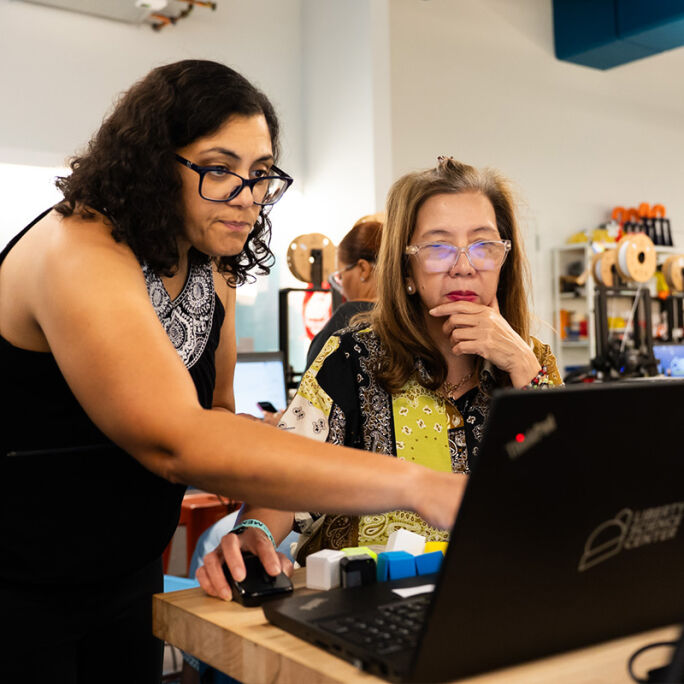
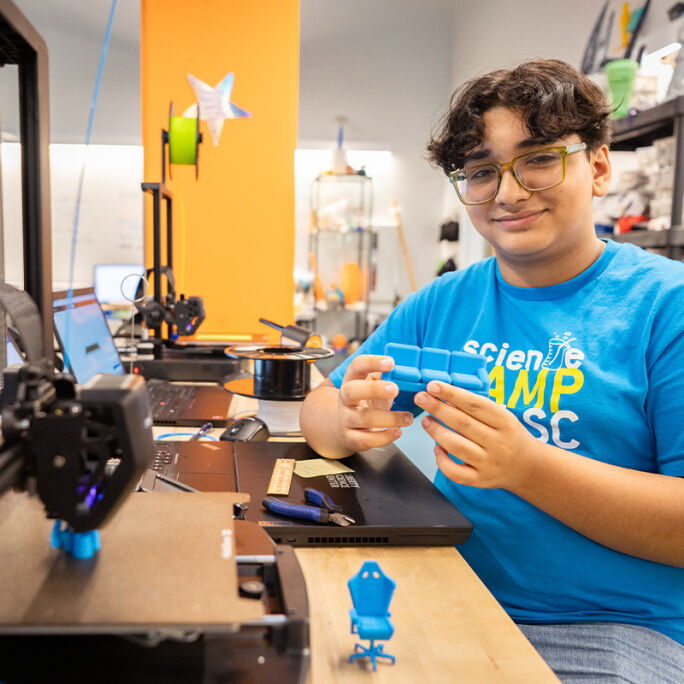
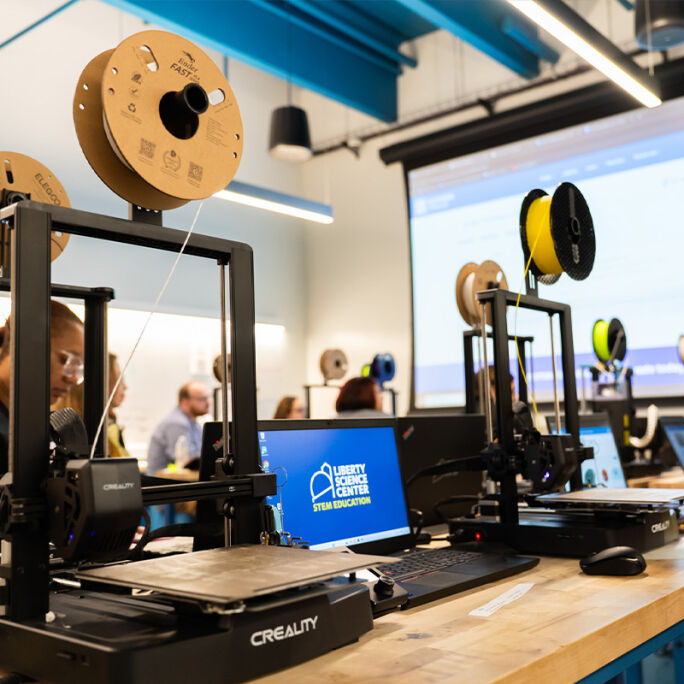
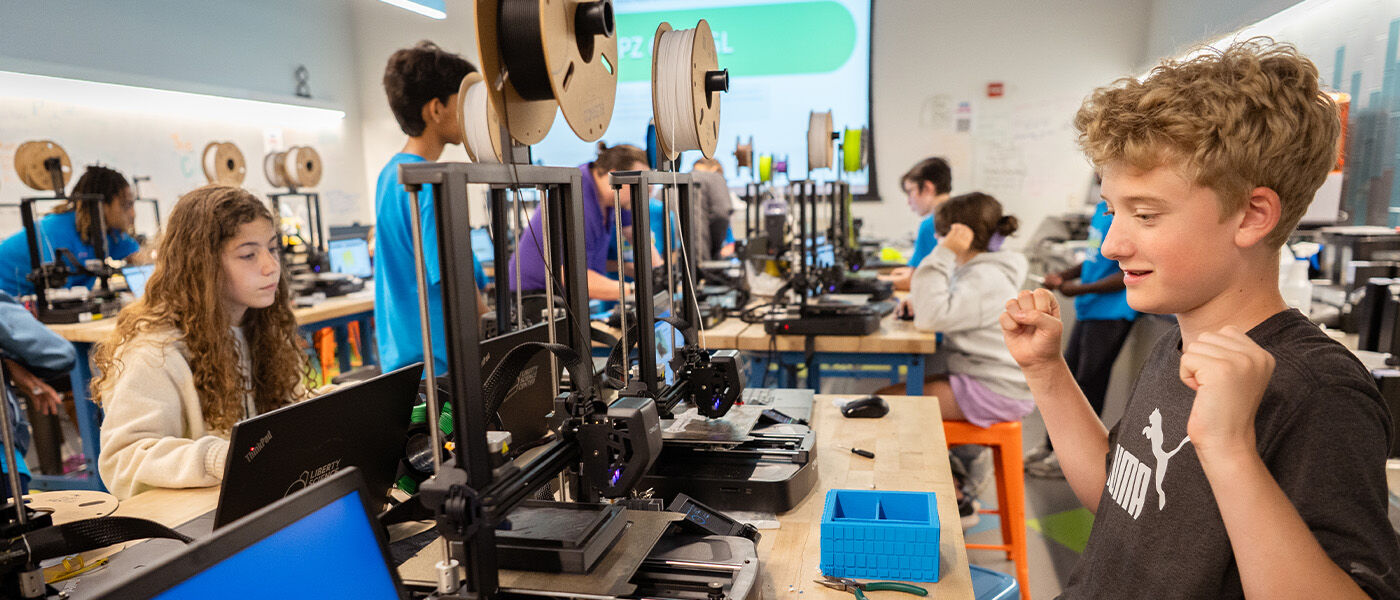
LSC’s MakerLab and Tech & Design Studio bring technology and creativity to life.
MakerLab workshops celebrate and encourage the creative, curious, and inventive spirits that all students have. The maker culture is at the heart of these workshops where students will use 3-D software to design innovative solutions for tomorrow’s problems.
Tech & Design Studio workshops introduce exciting technology skills to students. Each student works to apply computational thinking and design principles to identify solutions or create dynamic projects.
Programs must be booked in advance. Please call 201.253.1337, email partnerships@lsc.org, or fill out our info form.
Grades 3 – 5
Arduino: Morse Code (45 Minutes)
Available at LSC or online. Use TinkerCad Circuits to design and program a virtual light to transmit a message in Morse code. Learn the fundamentals of programming, basics of electronic circuits, and explore an older but well used form of communication. Alignment to NJSLS - Science 3-5-ETS1-2 Generate and compare multiple possible solutions to a problem based on how well each is likely to meet the criteria and constraints of the problem. 4-PS3-4 Apply scientific ideas to design, test, and refine a device that converts energy from one form to another. Connections to NJSLS - English Language Arts W.4.8 Recall relevant information from experiences or gather relevant information from print and digital sources; take notes and categorize information, and provide a list of sources. Connections to NJSLS - Mathematics 4.OA.A.3 Solve multistep word problems posed with whole numbers and having whole- number answers using the four operations, including problems in which remainders must be interpreted. Represent these problems using equations with a letter standing for the unknown quantity. Assess the reasonableness of answers using mental computation and estimation strategies including rounding. Alignment to NJSLS - Computer Science & Design Thinking 8.1.5.AP.6 Develop programs using an iterative process, implement the program design, and test the program to ensure it works as intended.
Bubble-tastic Engineering (45 Minutes)
Available online or at LSC. Unleash your bubble-tential and get ready to blow away the competition! In this program you will design a custom bubble-blowing device. Dive into the chemistry of these iridescent spheres, then mix and stir your way to the ideal bubble solution. Alignment to NJSLS - Science: 5-PS1-4: Conduct investigations to determine whether the mixing of two or more substances results in new substances. 3-5-ETS1-2: Generate and compare multiple possible solutions to a problem based on how well each is likely to meet the criteria and constraints of the problem. Connection to NJSLS - English Language Arts: W.5.7 Conduct short research projects that use several sources to build knowledge through investigation. Connection to NJSLS - Mathematics: MP.5 Use appropriate tools strategically.
Getting Started with AI (45 Minutes)
Available online or at LSC. How do machines know what they know? In this introduction to artificial intelligence, examine the concept of intelligence through interactive activities like intelligent paper and an invisible maze game. Gain a deeper understanding that intelligence goes beyond simple storage of knowledge. Alignment to NJSLS - Science: 3-5-ETS1-2 Generate and compare multiple possible solutions to a problem based on how well each is likely to meet the criteria and constraints of the problem. Connection to NJSLS - Mathematics: MP.2 Reason abstractly and quantitatively. MP.4 Model with mathematics.
Intro to Game Design (45-60 Minutes)
Available at LSC or online. Design custom characters, animations, and behaviors for video games. Use the platform Scratch to build a foundation for computational thinking, an essential skill in today’s tech-driven world. Alignment to NJSLS - Science: 3-5-ETS1-3 Plan and carry out fair tests in which variables are controlled and failure points are considered to identify aspects of a model or prototype that can be improved. Alignment to NJSLS - Computer Science and Design Thinking: 8.1.5.AP.3 Create programs that include sequences, events, loops, and conditionals. 8.1.5.AP.6 Develop programs using an iterative process, implement the program design, and test the program to ensure it works as intended. Connection to NJSLS - English Language Arts: RI.5.9 Integrate information from several texts on the same topic in order to write or speak about the subject knowledgeably. Connection to NJSLS - Mathematics: MP.5 Use appropriate tools strategically. Connection to NJSLS - Computer Science and Design Thinking: 8.2.5.ITH.2: Evaluate how well a new tool has met its intended purpose and identify any shortcomings it might have.
Grades 6 – 8
Design Thinking with Tinkercad (60-75 Minutes)
Available online or at LSC. Engage in the online digital creation of 3D models. Choose from three intriguing projects, each packed with excitement and innovation, and all achievable within a 45-minute timeframe.
- Project 1: Craft a Better Spoon for Toddlers - Design a toddler-friendly utensil that makes mealtime enjoyable, safe, and engaging.
- Project 2: Design a Medical Container or Eating Device for Parkinson's Patients - Enhance their independence, minimize spills, and ensure a comfortable dining experience.
- Project 3: Innovate a Solution for a Flood - Confront the critical challenge of designing a flood solution that mitigates the impact of floods and safeguards communities.
Alignment to NJSLS - Computer Science and Design Thinking: 8.2.8.ED.1 Evaluate the function, value, and aesthetics of a technological product or system, from the perspective of the user and the producer. 8.1.8.ED.3 Develop a proposal for a solution to a real-world problem that includes a model (e.g., physical prototype, graphical/technical sketch). Connections to NJSLS - Mathematics: MP.2 Reason abstractly and quantitatively.
Intro to Game Design (45-60 Minutes)
Available online or at LSC. Design custom characters, animations, and behaviors for video games. Use the platform Scratch to build a foundation for computational thinking, an essential skill in today’s tech-driven world. Alignment to NJSLS - Science: MS-ETS1-2 Evaluate competing design solutions using a systematic process to determine how well they meet the criteria and constraints of the problem. Alignment to NJSLS - Computer Science and Design Thinking: 8.2.8.ED.1 Evaluate the function, value, and aesthetics of a technological product or system, from the perspective of the user and the producer. 8.2.8.ED.4 Investigate a malfunctioning system, identify its impact, and explain the step-by-step process used to troubleshoot, evaluate, and test options to repair the product in a collaborative team. Connections to NJSLS - Mathematics: MP.2 Reason abstractly and quantitatively. 7.EE.3 Solve multi-step real-life and mathematical problems posed with positive and negative rational numbers in any form (whole numbers, fractions, and decimals), using tools strategically. Apply properties of operations to calculate with numbers in any form; convert between forms as appropriate; and assess the reasonableness of answers using mental computation and estimation strategies.
Coding Sphero: Golf (45 Minutes)
Available at LSC. Tee off into an adventure in the world of golf with Sphero, where precision meets strategy. Code and master the perfect roll, angles, and more. Alignment to NJSLS - Science: MS-ETS1-4 Develop a model to generate data for iterative testing and modification of a proposed object, tool, or process such that an optimal design can be achieved. Connection to NJSLS - English Language Arts: SL.8.5 Integrate multimedia and visual displays into presentations to clarify information, strengthen claims and evidence, and add interest. Connection to NJSLS - Mathematics: MP.2 Reason abstractly and quantitatively. Connection to NJSLS - Computer Science and Design Thinking: 8.1.8.AP.3 Design and iteratively develop programs that combine control structures, including nested loops and compound conditionals.
Code a 3D Printed Blinking Eye (45 Minutes)
Available at LSC. Combine coding and 3D printing technology with this exciting program. Construct a pre-printed 3D eye and program the printed eye to blink realistically using the iterative process and the C++ coding language. Alignment to NJSLS - Science: MS-ETS1-1 Define the criteria and constraints of a design problem with sufficient precision to ensure a successful solution, taking into account relevant scientific principles and potential impacts on people and the natural environment that may limit possible solutions. Connection to NJSLS - Mathematics: MP.2 Reason abstractly and quantitatively. Connection to NJSLS - Computer Science and Design Thinking: 8.1.8.AP.6: Refine a solution that meets users’ needs by incorporating feedback from team members and users.
Communicating Science with Pixel Art (45 Minutes)
Available online or at LSC. Discover the art of communicating science through pixel art! In this program, science and art converge to create digital illustrations or animations to showcase the phenomenon of light and its effects on droplets of water. Use an intuitive online STEAM toolset to explore physics in an mesmerizing way. Alignment to NJSLS - Science: MS-PS4-2 Develop and use a model to describe that waves are reflected, absorbed, or transmitted through various materials. Connection to NJSLS - English Language Arts: SL.8.5 Integrate multimedia and visual displays into presentations to clarify information, strengthen claims and evidence, and add interest.
Coding Sphero: Navigation (45 Minutes)
Available at LSC. Congratulations! You have been hired by a cutting-edge company developing obstacle detection using the Sphero bolt robot. In this program, your students will read and modify code in JavaScript to enhance their spheros' movement and understand the job of software engineering. Alignment to NJSLS - Science: MS-ETS1-2 Evaluate competing design solutions using a systematic process to determine how well they meet the criteria and constraints of the problem. Connection to NJSLS - English Language Arts: RST.6-8.9 Compare and contrast the information gained from experiments, simulations, video, or multimedia sources with that gained from reading a text on the same topic. Connection to NJSLS - Mathematics: 7.EE.3 Solve multi-step real-life and mathematical problems posed with positive and negative rational numbers in any form (whole numbers, fractions, and decimals), using tools strategically. Apply properties of operations to calculate with numbers in any form; convert between forms as appropriate; and assess the reasonableness of answers using mental computation and estimation strategies. Connection to NJSLS - Computer Science and Design Thinking: 8.1.8.AP.4: Decompose problems and subproblems into parts to facilitate the design, implementation, and review of programs.
VR Learning: Space and Black Holes (45 Minutes)
Available at LSC. Experience Verizon’s Visceral Science Learning Lab app with VR and study space as an immersive environment. Explore stars like never before to create supernovae, black holes, and more. This station-based program directs small groups of explorers to rotate between tables to engage in VR, AR, computer sims and physical learning models. Alignment to NJSLS - Science: MS-ESS1-2 Develop and use a model to describe the role of gravity in the motions within galaxies and the solar system. Connection to NJSLS - English Language Arts: SL.8.5 Integrate multimedia and visual displays into presentations to clarify information, strengthen claims and evidence, and add interest. Connection to NJSLS - Mathematics: 6.RP.A.1 Understand the concept of a ratio and use ratio language to describe a ratio relationship between two quantities.
Grades 9 – 12
NEW Nuclear Detective: Curse of the Walking Ghost (60 Minutes)
Available at LSC. Conduct an investigation, build a particle detector, and uncover the truth behind deadly events and urban legends based on a real-world nuclear meltdown. Alignment to NJSLS - Science: HS-PS1-8: Develop models to illustrate the changes in the composition of the nucleus of the atom and the energy released during the processes of fission, fusion, and radioactive decay. Connection to NJSLS - Mathematics: HSN-Q.A.1: Use units as a way to understand problems and to guide the solution of multi-step problems; choose and interpret units consistently in formulas; choose and interpret the scale and the origin in graphs and data displays. HSN-Q.A.2: Define appropriate quantities for the purpose of descriptive modeling HSN-Q.A.3: Choose a level of accuracy appropriate to limitations on measurement when reporting quantities.
Coming in Hot! Thermodynamics (60 Minutes)
Available at LSC. Master the laws of thermodynamics through hands-on design work! In this program, you have been hired by GrubClub to craft a new low-cost delivery box that can handle scorching heat and blistering cold at the same time. Learn about calorimetry and insulation as you build a prototype to face this challenge. Alignment to NJSLS - Science: HS-PS3-4 Plan and conduct an investigation to provide evidence that the transfer of thermal energy when two components of different temperature are combined within a closed system results in a more uniform energy distribution among the components in the system (second law of thermodynamics). Connection to NJSLS - Mathematics: MP.4 Model with mathematics.
Coding Sphero: Golf (45 Minutes)
Available at LSC. Get ready to tee off into a golf adventure in the world of “Golf with Sphero,” where precision meets strategy. Code and master the perfect roll, angles, and more. Alignment to NJSLS - Science: MS-ETS1-4 Develop a model to generate data for iterative testing and modification of a proposed object, tool, or process such that an optimal design can be achieved. Connection to NJSLS - English Language Arts: SL.8.5 - Integrate multimedia and visual displays into presentations to clarify information, strengthen claims and evidence, and add interest. Connection to NJSLS - Mathematics: MP.2 Reason abstractly and quantitatively. Connection to NJSLS - Computer Science and Design Thinking: 8.1.8.AP.3 Design and iteratively develop programs that combine control structures, including nested loops and compound conditionals. 8.1.12.CS.4 Develop guidelines that convey systematic troubleshooting strategies that others can use to identify and fix errors.
Coding Sphero: Navigation (45 Minutes)
Available at LSC. Congratulations! You have been hired by a cutting-edge company developing obstacle detection using the sphero bolt robot. In this program, your students will read and modify code in JavaScript to enhance their spheros' movement and understand the job of software engineering. Alignment to NJSLS - Science: HS-ETS1-2 Design a solution to a complex real-world problem by breaking it down into smaller, more manageable problems that can be solved through engineering. Connection to NJSLS - Mathematics: MP.4 Model with mathematics. Connection to NJSLS - Computer Science and Design Thinking: 8.1.12.AP.5 Decompose problems into smaller components through systematic analysis, using constructs such as procedures, modules, and/or objects.
Intro to Onshape (45 Minutes)
Available at LSC or online. Encounter the art of 3D design with Onshape, a cloud-based CAD platform. This intuitive parametric modeling tool is perfect for acquiring future-ready skills in modern engineering and design. Alignment to NJSLS - Science: HS-ETS1-4 Use a computer simulation to model the impact of proposed solutions to a complex real-world problem with numerous criteria and constraints on interactions within and between systems relevant to the problem. Connections to NJSLS - English Language Arts: RST.11-12.7 Integrate and evaluate multiple sources of information presented in diverse formats and media (e.g., quantitative data, video, multimedia) in order to address a question or solve a problem.Connection to NJSLS - Mathematics: MP.4 Model with mathematics. Connection to NJSLS - Computer Science and Design Thinking: 8.2.12.ED.4 Design a product or system that addresses a global problem and document decisions made based on research, constraints, trade-offs, and aesthetic and ethical considerations and share this information with an appropriate audience. 21st Century Life and Career Skills: 9.3.12.AR‐VIS.3 Analyze and create two- and three-dimensional visual art forms using various media.
Laser Cutting and Vector Drawing with Onshape (45 Minutes)
Available at LSC or online. Learn the basics of vector drawing and laser cutting. Using Onshape, learn how to create and manipulate simple shapes, combine them into complex designs, and prepare your own creations for laser cutting. This hands-on class will also include a live demonstration of laser cutting so you can see your digital designs transformed into physical objects. Alignment to NJSLS - Science: HS-ETS1-4 Use a computer simulation to model the impact of proposed solutions to a complex real-world problem with numerous criteria and constraints on interactions within and between systems relevant to the problem. HS-PS4-5 Communicate technical information about how some technological devices use the principles of wave behavior and wave interactions with matter to transmit and capture information and energy. Connection to NJSLS - Mathematics: MP.4 Model with mathematics. Connection to NJSLS - Computer Science and Design Thinking: 8.2.12.ED.4 Design a product or system that addresses a global problem and document decisions made based on research, constraints, trade-offs, and aesthetic and ethical considerations and share this information with an appropriate audience. 21st Century Life and Career Skills: 9.3.12.AR‐VIS.3 Analyze and create two and three‐dimensional visual art forms using various media.