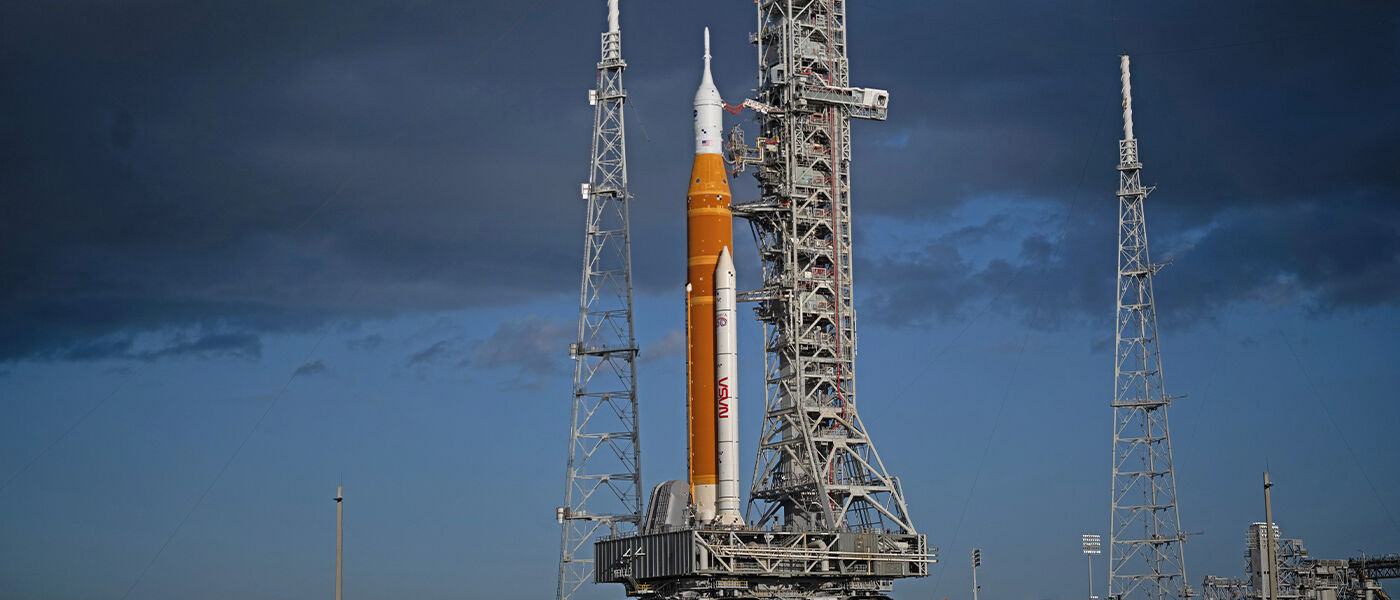
Artemis II Launch Set for April 1
On Wednesday, April 1, NASA plans to launch the Artemis II mission—humanity’s first time sending humans around the moon since 1972! The launch is targeted for no earlier than 6:24 p.m. EDT with a two-hour launch window. This will be the second mission in NASA’s Artemis program and the first to feature astronauts on board. The crew of this historic mission is made up of three American astronauts—Reid Wiseman, Victor Glover, and Christina Hammock Koch—and one Canadian astronaut, Jeremy Hansen.

The Artemis II crew in an Orion simulator at NASA’s Johnson Space Center in Houston. From left to right, Jeremy Hansen, Victor Glover, Reid Wiseman, and Christina Hammock Koch
They will blast off from Cape Canaveral, Florida, and then fly by the far side of the moon, getting as close as 4,600 miles above the lunar surface. At this point, the moon will be near its farthest distance from Earth in its orbit which means they will travel farther from the Earth than any humans have before. That’s not the only history being made, however. This flight will make Victor Glover the first African American, Christina Hammock Koch the first woman, and Jeremy Hansen the first Canadian to ever travel around the moon.
This mission serves as a test for critical systems on the 322-foot-tall Space Launch System rocket, and the Orion Capsule, which holds the astronauts and will actually fly around the moon and return to Earth. For example, astronauts will be tasked with testing docking procedures that will be necessary for a lunar landing in a later Artemis mission by docking with a spent part of the rocket before traveling on to the moon.
Originally, NASA had planned to land humans on the moon in the Artemis III mission but later announced a change in plans. Set to launch in 2027, Artemis III will now be a mission that will stay in orbit around Earth, allowing NASA to test operations between the Orion capsule and a lunar lander. Artemis IV, targeted to launch in early 2028, will be the mission to put humans on the moon for the first time since 1972.
Image Credit: NASA/Joel Kowsky