Ripples in the Cosmic Ocean with Dr. Dagomar Degroot
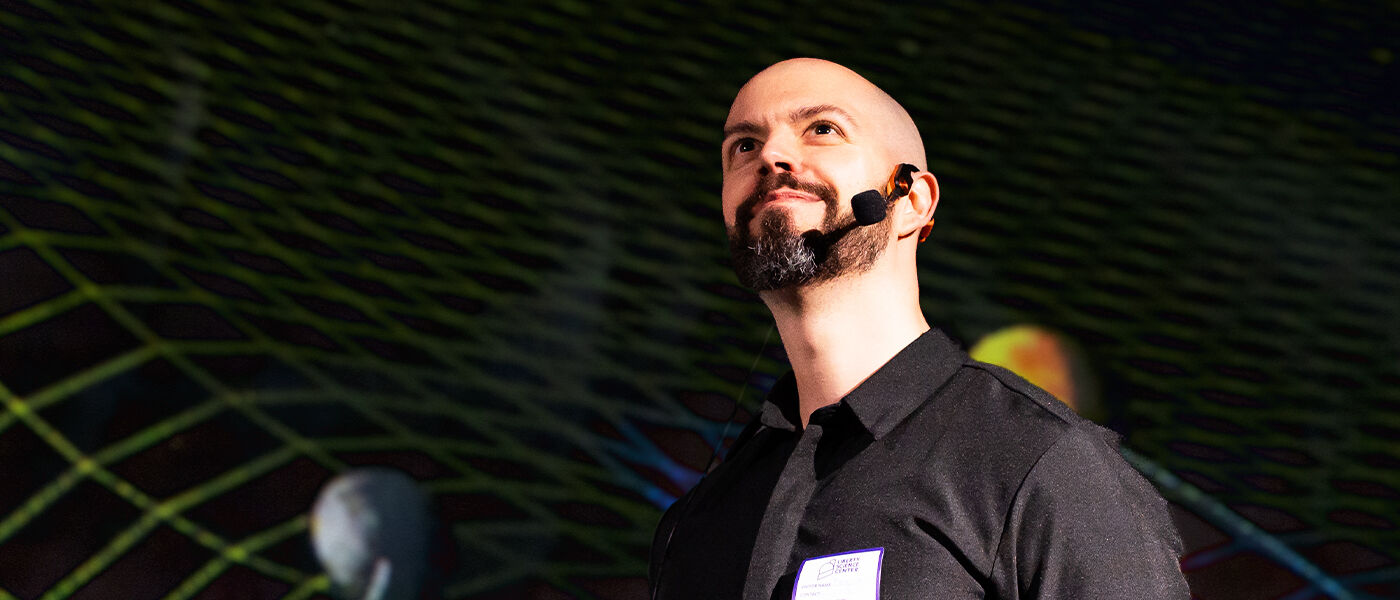
On April 16, 2026, Liberty Science Center was thrilled to host Dr. Dagomar Degroot, professor of environmental history at Georgetown University and author of Ripples on the Cosmic Ocean, for our latest Space Talk.
Our solar system is a very, very busy place. Home to one star, eight planets, five dwarf planets, hundreds of moons, and millions of other objects like asteroids and comets. Our lives on Earth today, and across human history, have been impacted by events and changes on these other bodies. Dr. Degroot, using the largest planetarium in the country, took us on a tour of the solar system highlighting just a few of the ways our Earth has been impacted by our neighbors.
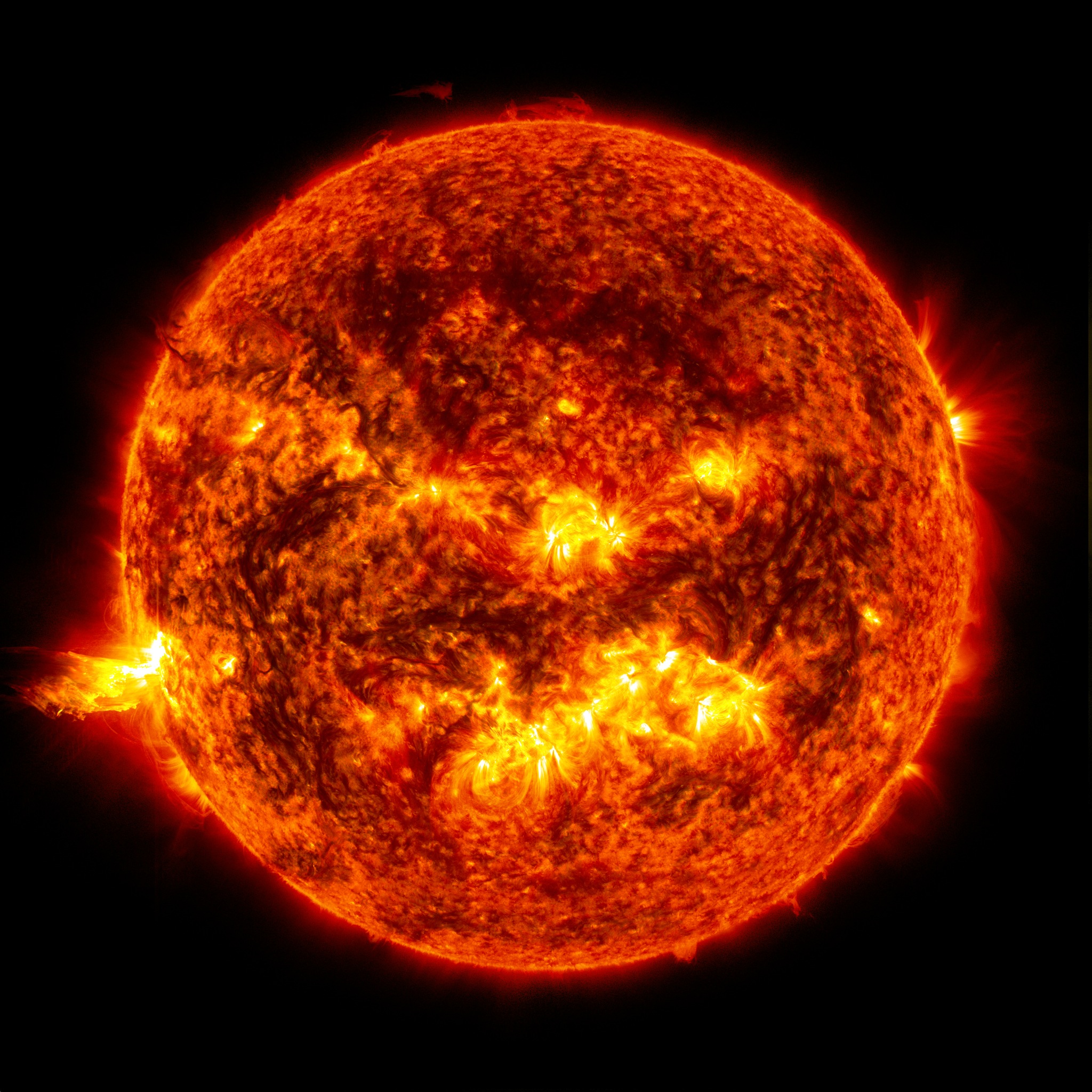
The sun, without a doubt, is the body in the solar system that affects Earth the most. Its gravity holds the Earth in orbit while giving the perfect amount of heat and light to sustain life. Today, the sun is mostly a stable place but if we watch it closely (and safely!) we notice it is a dynamic, always changing place. Very rarely, the surface of the sun experiences powerful explosions called coronal mass ejections, or CMEs. When these are pointed toward Earth, they can send huge amounts of charged particles hurtling toward the planet and cause geomagnetic storms that can disrupt power grids, damage satellites, and create visible auroras. The most dramatic and impactful CME occurred in 1859 and was called The Carrington Event. It caused auroras to be visible all over the globe, shutting down large parts of the only major electrical system in existence at the time – the telegraph system. These events are very rare but serve as a reminder of the sun’s influence on humans.
Credit: NASA/SDO
An image of the sun, taken in June 2013 by the Solar Dynamics Observatory, of a coronal mass ejection, seen on the left side of the sun.
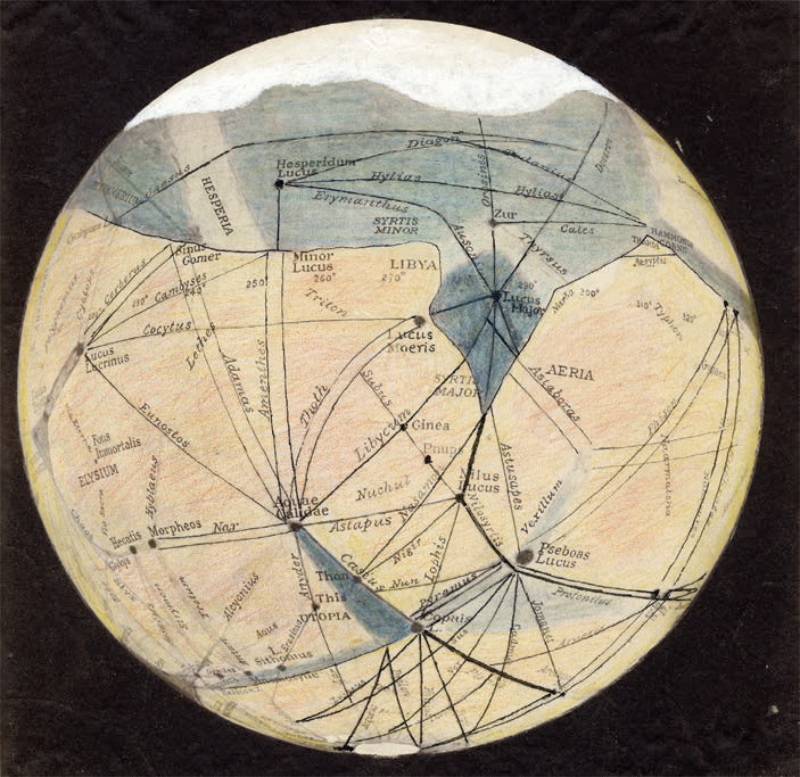
While the planet Mars doesn’t have major impacts on Earth, humans throughout history have been fascinated by the possibilities of the Red Planet. When we first had telescopes powerful enough to see the surface of Mars, late 19th century astronomers like Giovanni Schiaparelli and Percival Lowell thought they saw something incredible – interconnected canals that were clearly signs of an advanced alien civilization. This prompted speculation of what life on Mars would be like and whether it would be a threat to life on Earth, leading to dramas like “The War of the Worlds” that depicted this life on Mars as an invading force ready to take over our planet. Since then, however, we have learned that there is no current life on Mars and what these astronomers believed to be canals are actually natural rock formations and differing colored dust on certain sections of the planet.
Credit: Lowell Observatory Archives
Percival Lowell’s 1905 hand-drawn map showing what he saw on the Red Planet —Martian canals, oases, and meltwater lakes—which he believed to be evidence of an advanced alien civilization on Mars.
As telescopes become more and more powerful, we have discovered more than 1 million asteroids, small rocky bodies that orbit the sun, and believe that millions more are present in the solar system waiting to be discovered. Sparked by our discovery in the 1980s that one of these asteroids caused the extinction of non-avian dinosaurs 66 million years ago, humans have naturally been concerned with a similar event happening in modern times. Dr. Degroot walked our audience through the history of asteroid-safety research, starting with research projects done at MIT in the spring of 1967, to develop ways to deflect a potentially dangerous asteroid. Most recently, NASA’s Double Asteroid Redirection Test (DART) mission proved that we could alter the trajectory of an asteroid by smashing a small spacecraft into the asteroid Dimorphos in 2022. We were even able to pay a visit to the Maui Space Surveillance Complex in Hawaii, one observatory where asteroids that could pose a threat to Earth are studied.
We thank Dr. Degroot for exploring some of the ways our planet is impacted by other objects in the solar system, and putting some of our fears at ease about another asteroid extinction event. Join us for our next Space Talk, Little Talk of Exoplanets, on May 28 when we will welcome back Dr. Joshua Winn, Professor of Astrophysical Sciences at Princeton and author of The Little Book of Exoplanets.