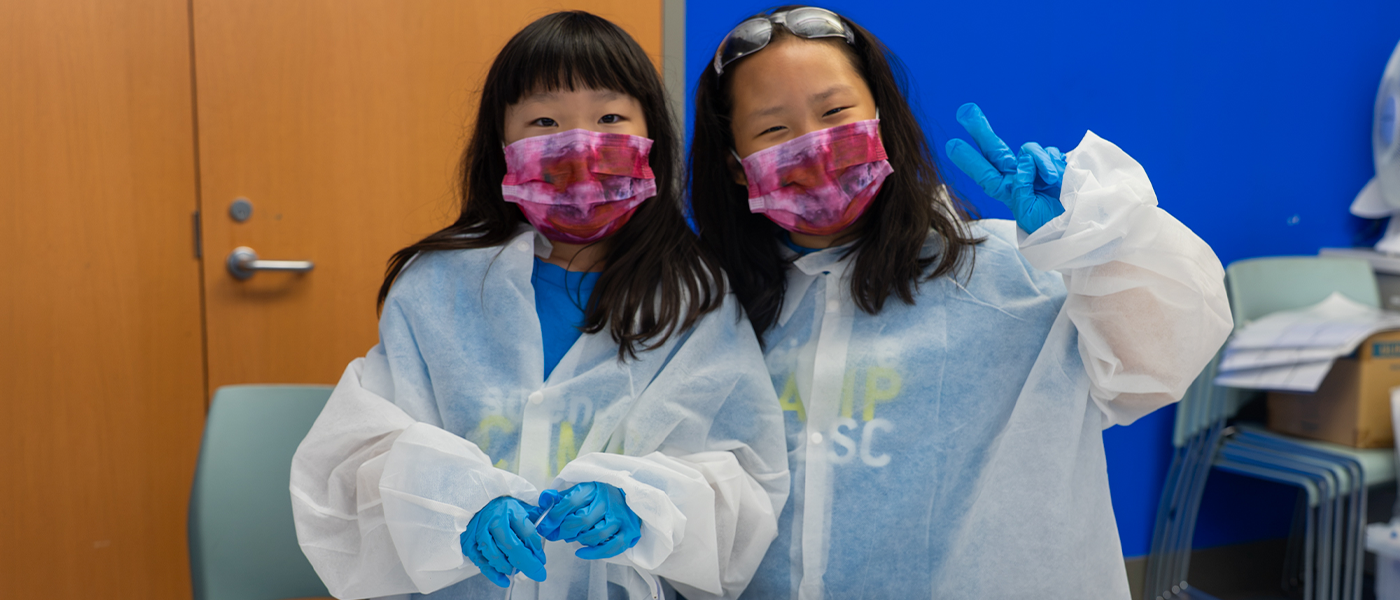
LSC’s Science Camp: Campers Explore the Science of Life with Anatomy Academy
What do strawberries, squid, sheep brains, and blue-tongued skinks have in common? Each can help young scientists better understand the diversity of life on Earth.
During the second week of LSC’s Science Camp, rising fourth and fifth graders entered the Pi Lab for Anatomy Academy, a medical science-themed week focused on comparative anatomy, dissection, and the connections between living organisms.
Throughout the week, campers explored how living organisms are connected through common ancestry, anatomy, and adaptation. They began by building a hypothetical species family tree using candy and extracting DNA from strawberries before practicing their dissection skills with lily flowers and button mushrooms.
As they moved into the animal kingdom, campers compared quahogs and shortfin squid, discovering that both are mollusks with shells, although a squid’s shell is an internal structure called a pen. They also examined cattle eyes, sheep brains, and pig hearts, identifying similarities between these organs and their own anatomy.
Larger dissections of American butterfish, American bullfrogs, and spiny dogfish encouraged campers to compare body structures and consider how different animals move, breathe, feed, and survive. Using reference sheets, they recorded observations, identified organs and tissues, and supported their conclusions with evidence.
Dissection has been an important scientific practice for centuries because it allows learners to examine structures that cannot be fully understood through diagrams or models alone. By carefully studying real specimens, campers could see how organs and tissues are arranged, compare different species, and consider how anatomy helps organisms survive.
Anatomy Academy gave campers a unique opportunity to investigate life through dissection, observation, and comparison.
Learn more information about Science Camp at LSC here.