Celebrating Reptile & Amphibian Awareness Day with Project Terrapin
Here at Liberty Science Center, we couldn’t be any more excited about Reptile & Amphibian Awareness Day (Oct. 21)! Taking a walk through our Wild About Animals exhibition, you’ll see countless species from the herpetological world: Turtles, tortoises, snakes, lizards, frogs, and more! But this 3rd floor gallery isn’t the only place to find our scaly ambassadors. Did you know that we also have reptiles in Our Hudson Home on the 4th floor? This exhibit highlights everything there is to know about the Hudson River and its resident animals.
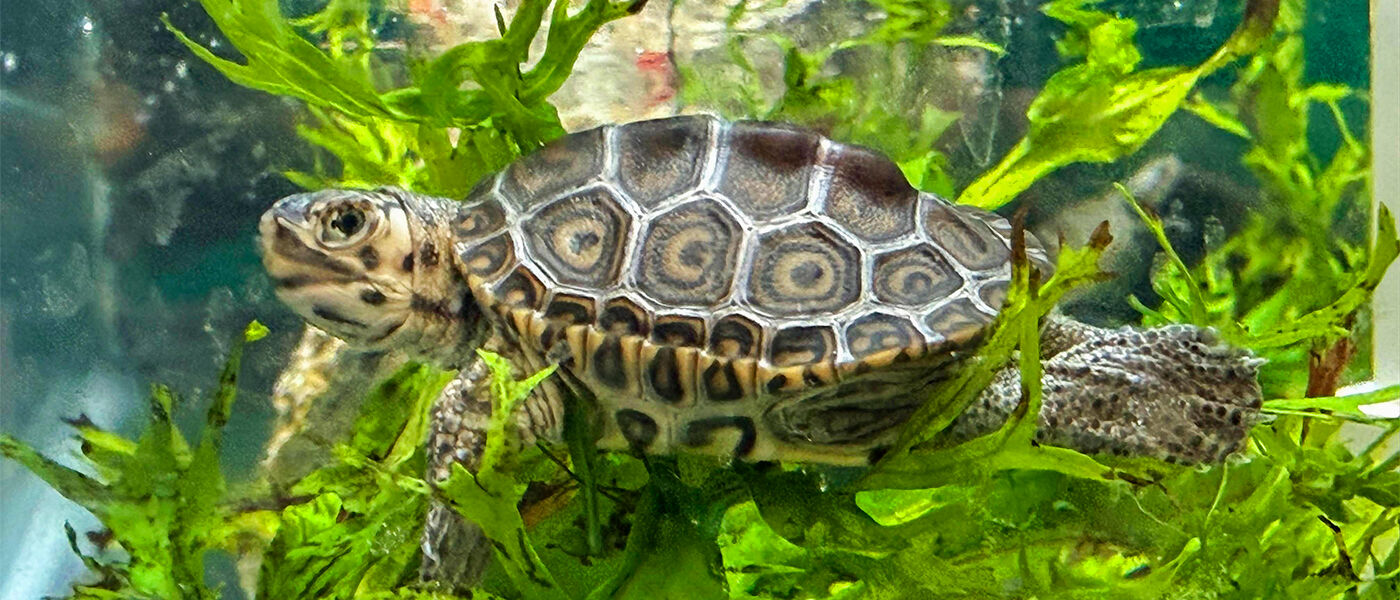
As you stroll past the big satellite map at the entrance and the open harbor tank with some of our largest fish species, you’ll then spot our salt marsh tank, where you can meet the gallery’s reptilian residents— our diamondback terrapins! With a shell pattern that dazzles like diamonds, these turtles are hard to miss. This species is not only a highlight for the gallery, but also a staple of our local meadowlands habitat.
These semi-aquatic turtles can be found in nearby estuaries; habitats where fresh water from the river meets and mixes with the ocean’s salt. That salty and fresh mix results in what’s known as brackish water, a type of H₂0 that these terrapins are very familiar with. Something that makes them unique compared to other turtles is their ability to live exclusively in brackish water, which is something rather uncommon for turtles. How can they survive with all of that salt, you might ask? Well, these terrific terrapins are equipped with salt glands by their eyes that remove salt from their bodies and secrete tears with high concentrations of sodium chloride. In other words, they can flush out extra salt from their bodies!
Diamondback terrapins are an omnivorous species, spending their days searching for small fish, invertebrates, and vegetation. They are sexually diamorphic with females noticeably larger (around 6-9 in.) compared to the males of the species (around 4-5.5 in.). Females will take advantage of the habitat’s sand to make a nest where they can lay a clutch of up to 20 eggs. Believe it or not, the temperature of the soil will predict if eggs will hatch into males or females. Cooler soil temperatures below 82° Fahrenheit will result in males; warmer soil temperatures above 86° Fahrenheit will result in females. Temperatures that fall in between those ranges can result in either male or female hatching.
They’re a fascinating reptile to see when visiting estuaries, but their populations aren’t as abundant as they once were. According to the IUCN List of Threatened Species, the diamondback terrapin is listed as vulnerable as a result of multiple threats. Like other animals in their surrounding habitat, they are vulnerable to the numerous effects of climate change, habitat loss, road collisions, crab potting, and pollution.
With the number of threats these terrapins face, it’s fair to ask, ‘What can be done to save this species?’ Fortunately, there is hope for these turtles. There is a lot that can, and is, being done to increase their numbers.
A project that has been making a splash across New Jersey classrooms, and now LSC, is the Hatchling Head Start Program. The idea behind the program is to have others raise terrapin hatchlings that were abandoned as eggs so they can be released back into the wild with a better chance at survival than they had before. Many schools in the state have contributed to this effort to not only help these animals, but also to teach their students about ecological responsibility and conservation.
Liberty Science Center’s mission is to inspire the next generation of scientists and engineers and excite learners of all ages about the power, promise, and pure fun of science and technology. This mission statement echoes throughout each exhibit and program in the institution and is a driving force behind why LSC is taking part in the hatchling head start program with Project Terrapin; an organization committed to the welfare and conservation of New Jersey’s diamondback terrapin populations. Currently, we are raising nine young diamondback terrapins at LSC and will release them back into their native habitat during the warmer months.
If you are interested in seeing these marvelous animals, you can come to LSC’s Our Hudson Home exhibition and visit our two resident adult diamondback terrapins in our salt marsh tank, along with other incredible local wildlife that can be found throughout the gallery. If you would like to see more of our reptiles, amphibians, and other ambassador animals, you can visit our Wild About Animals gallery and our new premium exhibition, The Power of Poison.