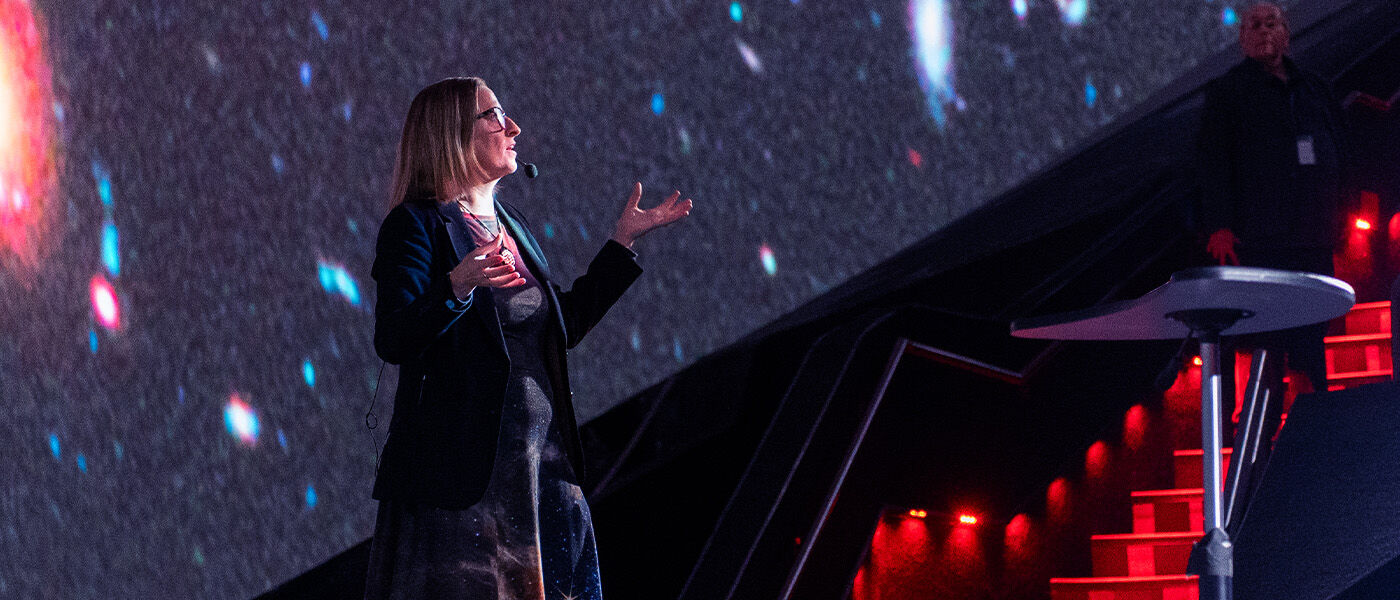
Get Lost in Space: Space Talk with Dr. Emily Rice
On October 29, 2026, LSC was thrilled to host Dr. Emily Rice, Associate Professor of Astrophysics at Macaulay Honors College of the City University of New York, for her second Space Talk: Get Lost in Space (Telescope Images).
Since humans first used telescopes more than 400 years ago, we have strived to improve them to help us unfold the mysteries of the cosmos. Perhaps our biggest leap forward was putting telescopes in space, beginning in the 1960s. By placing telescopes in space, we get them away from Earth’s atmosphere which can block certain wavelengths of light and cause distortions in others, interfering with their views of the universe. Dr. Rice took us on a journey through the history of space telescopes and other tools we use to explore space during her Space Talk.
While it wasn’t the first space telescope, the Hubble Space Telescope, launched in 1990, was the first large sophisticated telescope to be launched into space. Many of the stunning images of the cosmos you have seen have likely been captured by its almost-8-foot diameter mirror 300 miles above the surface of Earth. This includes the famous Hubble Deep Field, an image in which we can see thousands of galaxies in a tiny portion of the sky—giving us one of the first true glimpses of the scale of the universe. Hubble revolutionized our understanding of the universe and is still active today.
Credit: R. Williams (STScI), the Hubble Deep Field Team and NASA/ESA
The Hubble Space Telescope’s first deep field, taken in 1995, shows thousands of galaxies in an area of the sky the size of a dime held up 75 feet away.
While the Hubble Space Telescope focuses on ultraviolet, visible, and near-infrared wavelengths of light, other space telescopes have been launched to study other parts of our electromagnetic spectrum. Highlighted by Dr. Rice were the Chandra X-ray Observatory (1999-present), which continues to observe X-ray light and the Spitzer Space Telescope (2003-2020) which studied Infrared light.
In recent years we have been lucky to see the launch of two brand new space telescopes. The James Webb Space Telescope was launched in 2021, and in many ways has been the successor to Hubble. Equipped with a mirror nearly 22 feet across, it is able to peer further away and deeper into the universe than any telescope built before. One of the first images the telescope released was its very own deep field, which serves as an incredible visual comparison with Hubble’s deep field to show how far our technology has come. Beyond studying the distant universe, JWST focuses on studying exoplanets and the life cycles of stars.
Credit: NASA, ESA, CSA, STScI
The James Webb Space Telescope’s first deep field, released in 2001, captures the deepest and sharpest infrared image of the Universe to date. This section of the sky, the size of a grain of sand held at arm’s length, is filled with thousands of galaxies. Toward the center of the image, we can see the light from some of the most distant galaxies in the Universe being bent and warped by the force of gravity of a galaxy cluster closer to us.
Launched on August 30, 2026, the Nancy Grace Roman Space telescope is set to become humanity’s next great tool to study the universe. The telescope, named after the “Mother of the Hubble Space Telescope” and NASA’s first chief of astronomy, is on its way to its final destination one million miles from Earth and is expected to begin observing the universe in early 2027.
Through the combined efforts of astronomers like Dr. Rice and incredible tools both in space and on Earth, we are reaching another golden age of astronomy when new discoveries are made at a dizzying pace!
We thank Dr. Emily Rice for joining us for her second Space Talk! Stay tuned for more information on our upcoming Space Talks.
