Images and Discoveries from the James Webb Space Telescope with Dr. Marcin Sawicki
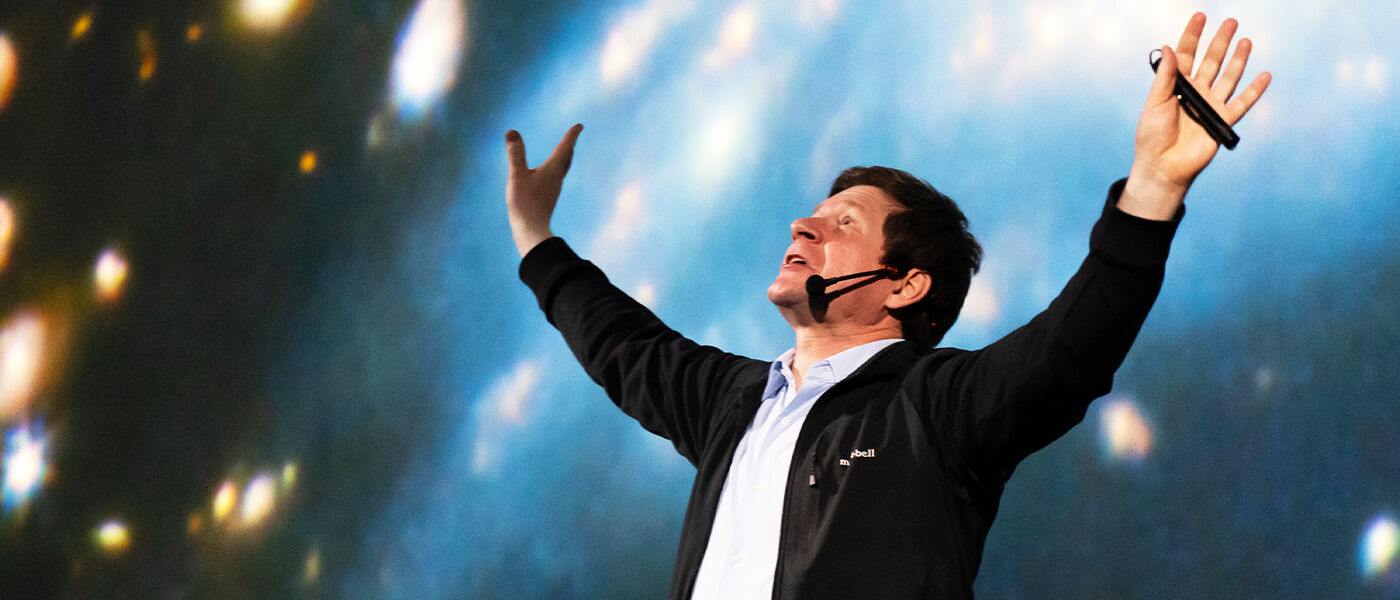
On March 13, 2026, Liberty Science Center was thrilled to host Dr. Marcin Sawicki, Professor of Astronomy and Physics at Saint Mary's University and author of Webb's Cosmos: Images and Discoveries from the James Webb Space Telescope, for our latest Space talk: Images and Discoveries from the James Webb Space Telescope.
After the James Webb Space Telescope launched in December of 2021, it soon became our best tool to study the cosmos. More than four years after it became active, Dr. Marcin Sawicki walked us through the incredible images it has taken of our Universe, and what it has helped scientists understand. Dr. Sawicki shared with us four major areas of study for the telescope: the origins of stars, the evolution of galaxies, finding the first generation of stars and galaxies, and finally discovering the properties of planets orbiting stars outside of our Solar System.
To help us understand the origins of stars, we were able to use the largest planetarium in the country to view incredible images of the Pillars of Creation and Carina Nebula, locations right here in our own galaxy where stars begin their lives. The telescope, thanks to the fact it sees in infrared light, is able to see through some of the cosmic dust in these massive clouds of gas and dust and see stars that are in the process of being born.

The Carina Nebula as seen by the James Webb Space Telescope. These cosmic cliffs are made of gas and dust which go into birthing new stars, the structure we see here is carved out by young stars pushing this gas and dust as they come to life.
Image Credit: NASA, ESA, CSA, STScI
When we look out into the furthest reaches of the Universe we are looking back in time, seeing it as it was billions of years ago, and in some cases, all the way back to the earliest stages of the Universe. In doing so, we are able to study how the earliest galaxies and stars came to be. The galaxy known as MoM-z14 is the most distant galaxy ever observed by JWST, showing us how it looked 13.6 billion years ago, just 280 million years after the beginning of the Universe. Early galaxies like these have been a major surprise to scientists as they appearing around 100 times brighter than expected, causing astronomers like Dr. Sawicki to reevaluate our theories of how, and how early, stars and galaxies are able to form.

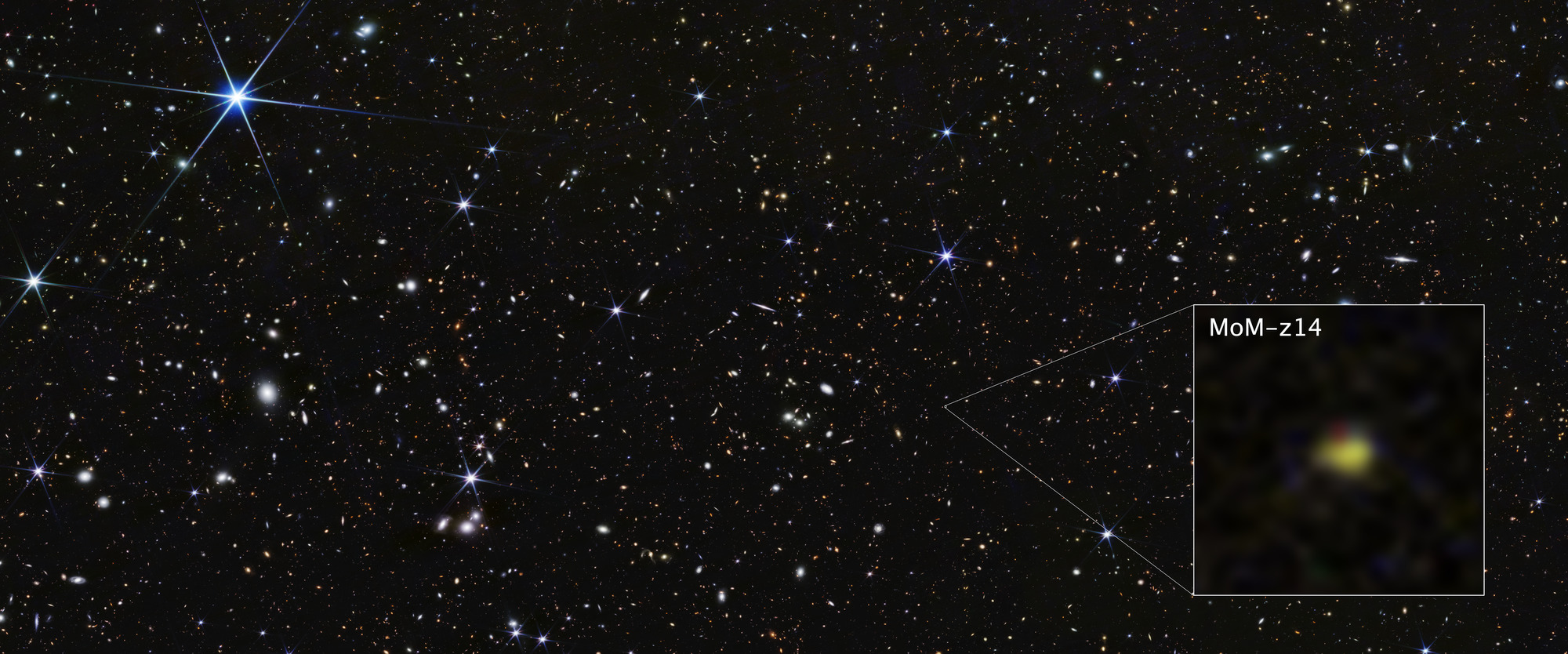
NASA’s James Webb Space Telescope shows galaxy MoM-z14 as it appeared in the distant past, only 280 million years after the universe began in the big bang.
Image Credit: NASA, ESA, CSA, STScI, Rohan Naidu (MIT); Image Processing: Joseph DePasquale (STScI)
One of the most exciting, and potentially groundbreaking, areas of JWST’s study is on exoplanets, planets that orbit stars outside of our Solar System. Thanks to the power of the telescope, it is able to both directly image exoplanets and measure the compositions of their atmospheres – helping us search for exoplanets with the potential to host life. One of the systems of exoplanets we focused on was HR 8799, located around 130 light years away and home to four gas giant exoplanets. Studying exoplanets in this way lets us study not only what they are like today but how they formed in the first place!

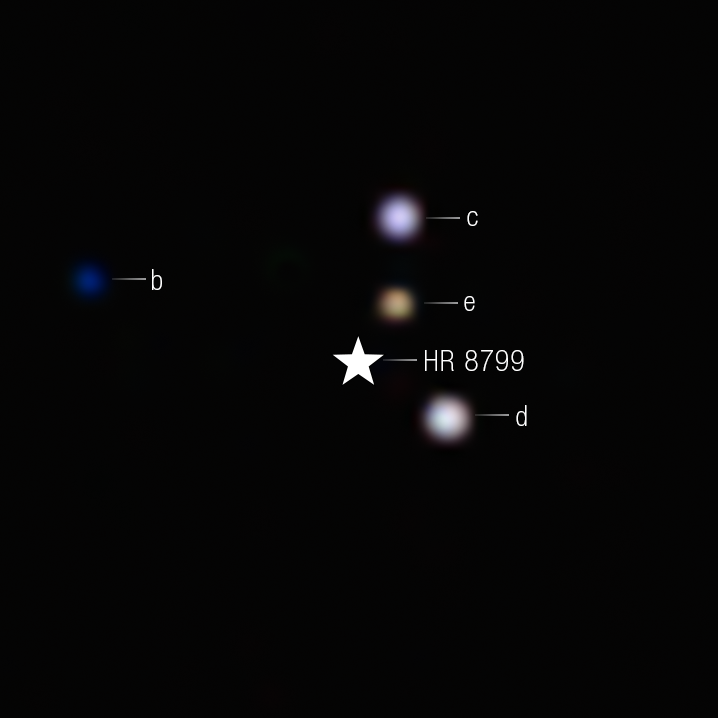
Image: NASA, ESA, CSA, STScI, Laurent Pueyo (STScI), William Balmer (JHU), Marshall Perrin (STScI)
NASA’s James Webb Space Telescope has provided the clearest look yet at the iconic multi-planet system HR 8799. The observations detected carbon dioxide in each of the planets, which provides strong evidence that the system’s four giant planets formed much like Jupiter and Saturn in our own solar system.
As amazing as these images and discoveries are so far, the telescope is just getting started! Based on its performance so far, engineers estimate it will remain active for another 10 to 15 years, giving us another decade of discovery.
Join us for our next Space Talk on April 16, 2026, as we welcome Dr. Dagomar Degroot, professor of environmental history at Georgetown University and author of Ripples on the Cosmic Ocean, as we explore the surprising threads linking human history to events throughout the Solar System.
Learn more about Space Talk here.
