Cloudy with a Chance of Starships: Space Talk by Dr. Seven Rasmussen
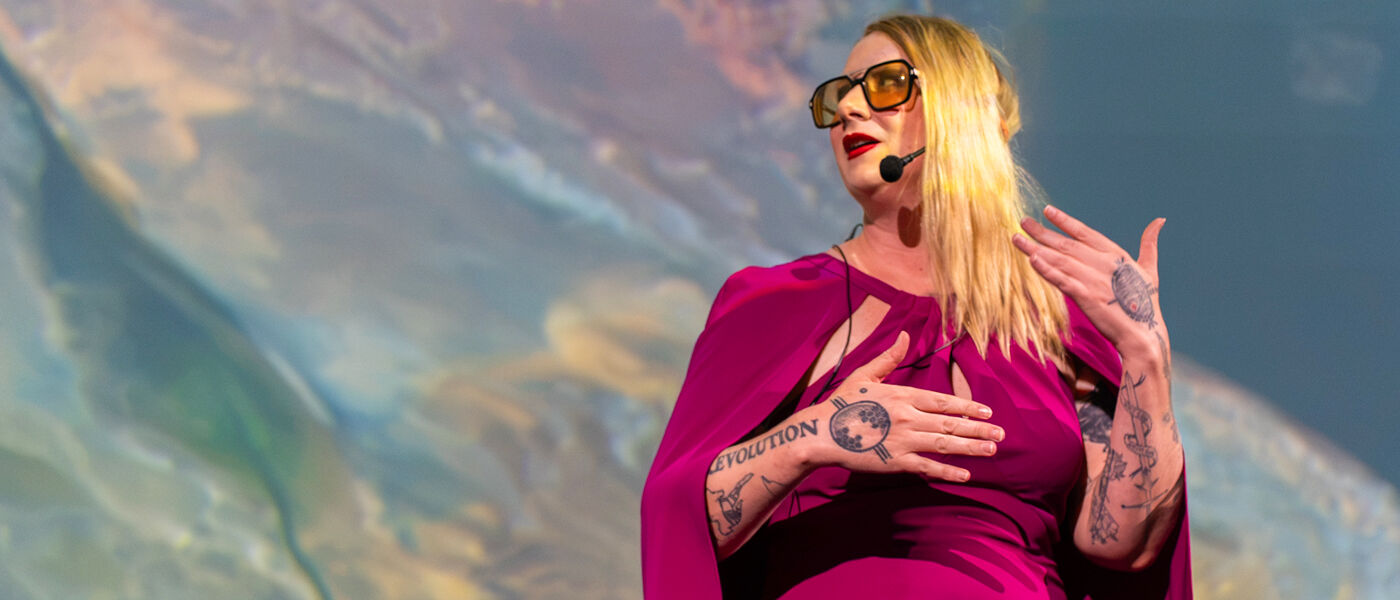
On August 27, 2026, Liberty Science Center was thrilled to host Dr. Seven Rasmussen, an instructor at Columbia University and author of the recently released book Cloudy with a Chance of Starships, for our latest Space Talk!
Are we alone in the universe? This has been one of humanity’s most fundamental questions for as long as we have been around. Of course, it is a difficult question that astronomers like Dr. Rasmussen are trying to answer! One of the ways we can wrap our minds around the search for intelligent life beyond Earth is through the Drake Equation, a framework proposed by astronomer Frank Drake that tries to break down a complex question into smaller pieces. Some of these pieces we can actually learn more about today, including the rate at which stars form in galaxies, how often those stars form planets and moons, and from there how likely it is that those planets and moons have the conditions to support life. Other pieces of the puzzle still require some guesswork, like how likely is it for life to actually form if the conditions are right, whether that life becomes intelligent, and whether that intelligent life is around at the same time we humans are.
)
Credit: NASA/JPL-Caltech/MSSS
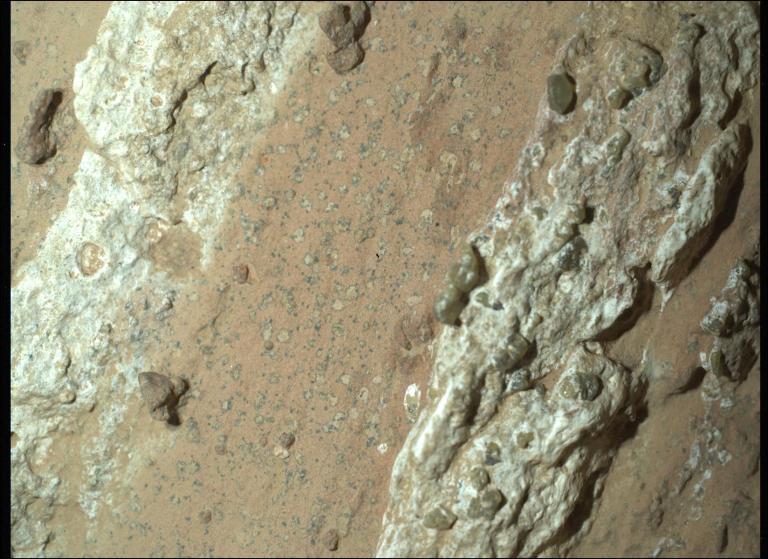
NASA’s Perseverance rover discovered leopard spots on a reddish rock nicknamed “Cheyava Falls” in Mars’ Jezero Crater in July 2024. Scientists think the spots may indicate that, billions of years ago, the chemical reactions in this rock could have supported microbial life; other explanations are being considered.
Leaving Mars behind, we visited moons of the outer planets in the solar system which Dr. Rasmussen says are the best possible places to find life in our solar system today. One of Jupiter’s moons, Europa, is an icy world on the outside, but just 10-15 miles beneath the surface we find a huge saltwater ocean, wrapping around the entire planet. It is possible that this ocean, like those on Earth, contains the building blocks of life. Keep your eyes out for the recently-launched Europa Clipper mission, scheduled to arrive at the moon in April 2030, that will study Europa and its ocean even more closely. Similar to Europa, evidence suggests that Triton, one of Neptune’s moons, could also contain a liquid water ocean, this one closer to 100 miles beneath the surface. Due to it being much farther away from us than Europa, and much more difficult to study, we don’t know nearly as much about Triton and its ocean but further study could reveal another place with the potential for life.
Last but not least on our trip through the solar system is Saturn’s largest moon, Titan. Titan has a surface unlike any other place in the solar system, featuring a thick atmosphere, oceans and lakes of liquid methane, and numerous organic molecules that could form the building blocks of life. Unfortunately, the surface is a frigid -290 °F meaning life as we know it is unlikely to form there, though there is always the potential for some unexpected kind of life to surprise us. Most promisingly, though, is Titan’s subsurface ocean. If those building blocks of life that are present on the surface can find their way into this ocean, Titan becomes the most promising place to find life in the solar system. To help us study the conditions on Titan, NASA will be launching the Dragonfly mission—a nuclear powered robotic drone that will be able to cover large distances on Titan’s surface. Dragonfly is scheduled to launch in July 2028, and land on Titan in late 2034.
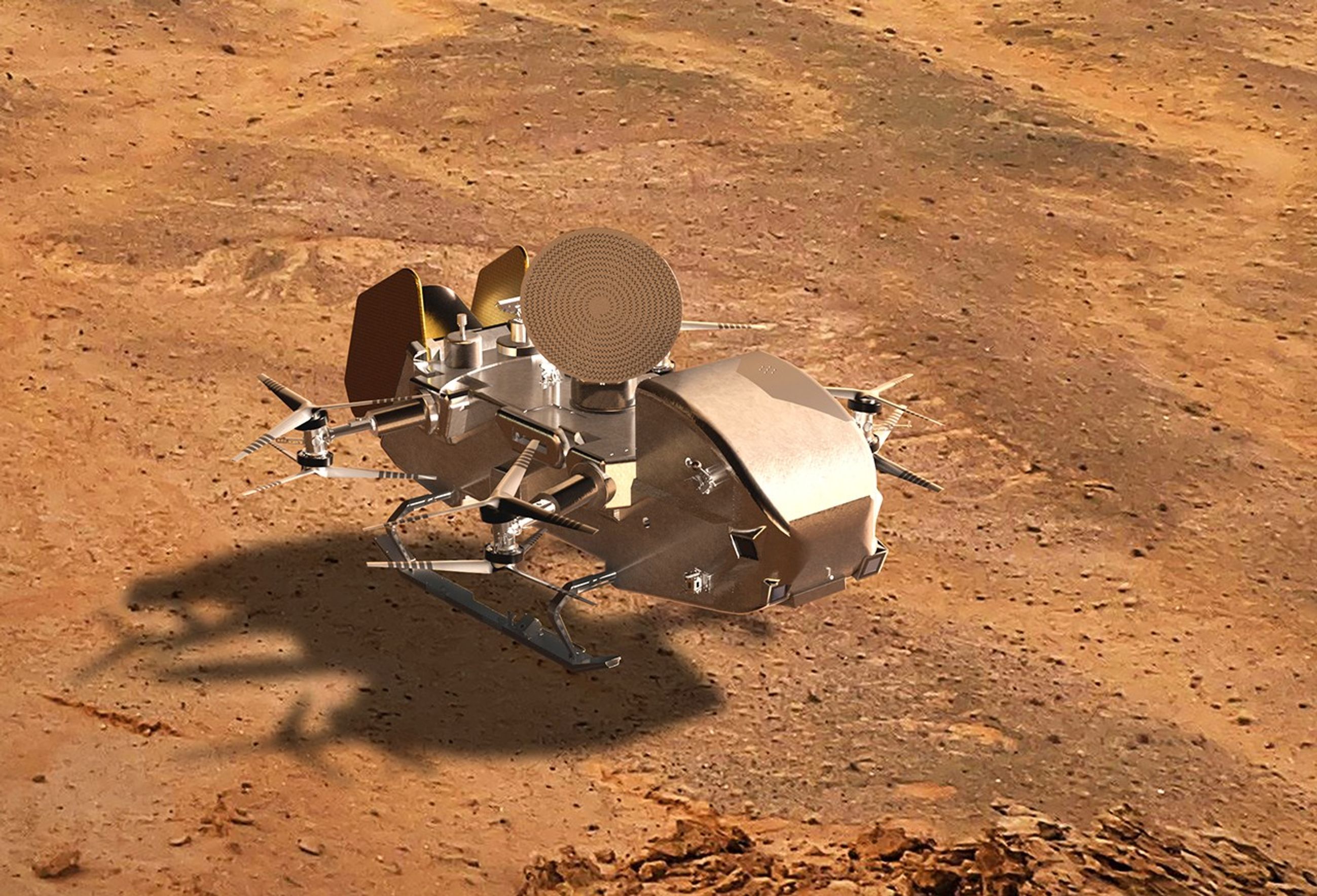
Artist's concept of NASA's Dragonfly on the surface of Saturn's moon Titan
Credit: NASA/Johns Hopkins APL/Steve Gribben
We thank Dr. Rasmussen for her incredible Space Talk! We will be making exciting upgrades to the planetarium during most of September, so our next Space Talk will be on October 27. We will welcome back Dr. Emily Rice, Associate Professor of Astrophysics at Macaulay Honors College of the City University of New York, for her second Space Talk: Get Lost in Space (Telescope Images).