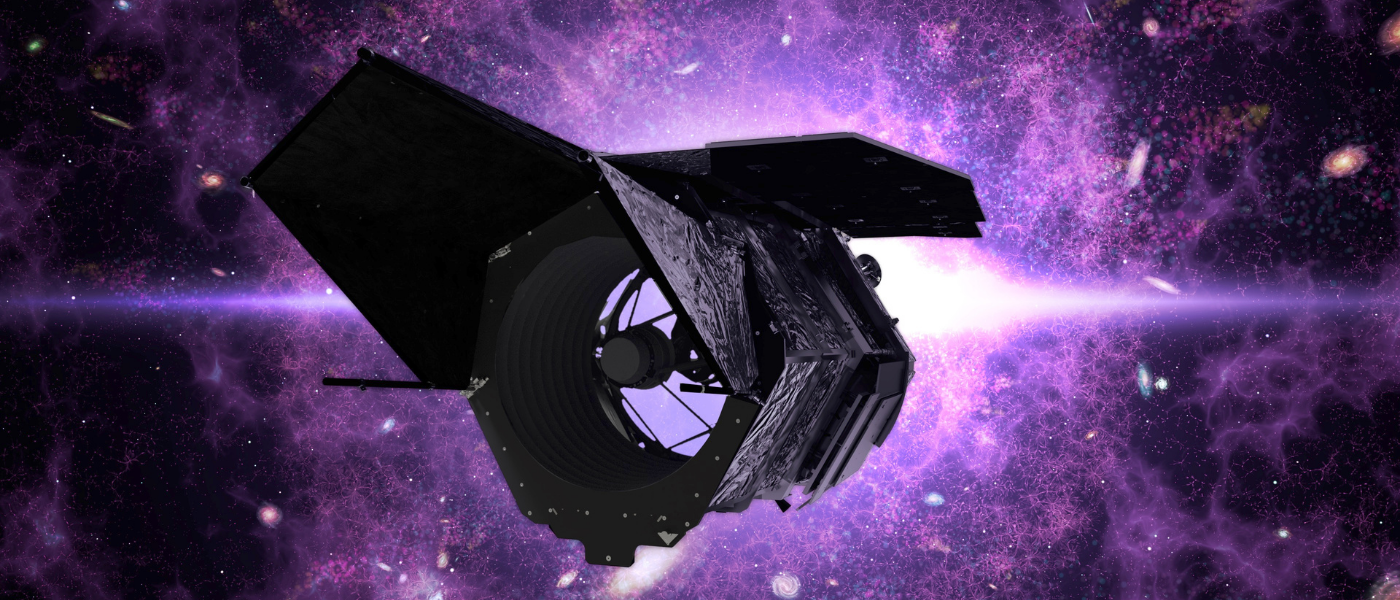
Nancy Grace Roman Space Telescope
On Sunday August 30, 2026 humanity’s next great tool to view the cosmos, the Nancy Grace Roman Space Telescope, was launched into space, beginning its journey to its new home around 1 million miles away from Earth. The telescope, named after the “Mother of the Hubble Space Telescope” and NASA’s first chief of astronomy, is expected to begin observing the Universe in early 2027 after its 3-month long journey.
Unlike other space telescopes you may have heard of, the Hubble and James Webb Space Telescopes, the Nancy Grace Roman Space Telescope is designed as a survey telescope. This means instead of focusing in great detail on individual objects, it will instead observe huge portions of the Universe at once, with 100 times the observational area as Hubble. Once operational, astronomers hope it will help us discover tens of thousands of new exoplanets – planets that orbit stars outside our solar system and study two mysterious parts of our universe, dark matter and dark energy.
This image compares the relative field of view of Hubble's Advanced Camera for Surveys to that of Roman's Wide Field Instrument on Hubble's mosaic of the Andromeda Galaxy. The Wide Field Instrument on Roman has a similar resolution to Hubble's Advanced Camera for Surveys, but it sees 100 times the area of sky in each observation.
In the hunt for tens of thousands of new exoplanets, the Nancy Grace Roman Space telescope will use two different techniques. The first is called the transit method, the same idea astronomers have used to find most of the over 5,000 exoplanets discovered to date. This is done by watching for planets to cross in front of its parent star, causing a small amount of its star’s light to be blocked that we can observe. In addition to that method, it will find exoplanets through gravitational microlensing, essentially searching for exoplanets bending light with their gravity.
To better study dark matter, a mysterious kind of matter that is invisible but still interacts with the rest of the Universe through gravity, the telescope will look for how gravity of clumps of dark matter bend light that passes near it, called gravitational lensing. Doing this on a large scale, with a goal of observing over 160,000 of these gravitational lenses, will allow us to map where dark matter is in the Universe in detail never done before.
Another of the Universe’s great mysteries is called dark energy, a pressure-like force that seems to be pushing the Universe apart causing it to expand faster and faster as time goes on. Like dark matter, it is invisible to our eyes but we can still observe the effects it has on the Universe around us. One way the Nancy Grace Roman Space Telescope will attempt to uncover dark energy’s mysteries is by comparing how fast galaxies are moving away from us with their distance from us. Making that comparison gives us clues about how fast the universe is expanding today and how fast it was in the past. The telescope hopes to make these measurements on tens of thousands of galaxies giving us even more data to better understand dark energy and how it has impacted the past and the future of the Universe.
To learn more about dark matter, dark energy, and other invisible forces shaping the Universe come check out our planetarium show, Black Holes and the Dark Cosmos, now showing in the Jennifer Chalsty Planetarium and be on the lookout for the first observations and data from the Nancy Grave Roman Space Telescope in early 2027!